Judith Sargent Murray
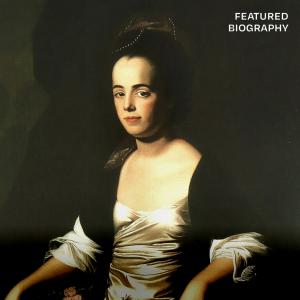
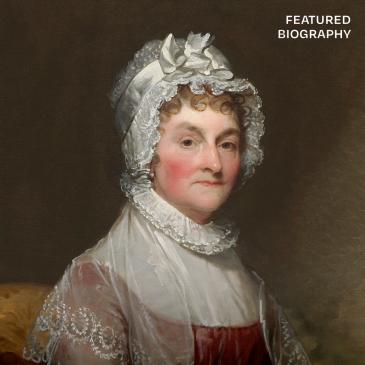
Judith Sargent Murray was a groundbreaking author, poet, playwright, and essayist who advocated for women’s political and educational equality.
She was a founding member of the first Universalist church in America, writing their early texts and calling on her religious background to support her proto-feminist ideas.
She was the first North American woman to have a regular newspaper column, The Gleaner, in which she used a male pseudonym to discuss political ideas and argue for Federalism.
“Is it upon mature consideration we adopt the idea, that nature is thus partial in her distributions? Is it indeed a fact, that she hath yielded to one half of the human species so unquestionable a mental superiority? I know that to both sexes elevated understandings, and the reverse, are common. But, suffer me to ask, in what the minds of females are so notoriously deficient, or unequal.”
Judith Sargent Murray, “On the Equality of the Sexes,” 1790
Early Life
Born on May 1, 1751 in Gloucester, Massachusetts, Judith Sargent was the oldest of eight children of the wealthy merchant family of Winthrop Sargent and Judith Saunders Sargent. Because reading and writing were the only topics taught to women, Murray relied on the vast family library to learn history, philosophy, geography, and literature. At age nine, she began writing poetry, which her father proudly read to family members. Often noting that her younger brother was privy to more educational opportunities, Sargent often reflected on how unjust the education system was towards girls and women, (The New York Historical).
In 1769, Sargent married John Stevens, a ship captain, and began taking her writing more seriously. She began saving her letters because she believed they could be historically significant to future generations. She supported Independence from Great Britain when the American Revolution began in 1775, even though it threatened her family’s wealth in trade. She favored Independence because she hoped that a new government would lead to greater opportunities for women (The New York Historical).
The Sargent family was heavily involved in the Universalist church in North America. Sargent was a founding member of the first Universalist church in North America in 1779, through her family’s prominence in the church. She wrote the first American Universalist catechism, a summary of their religious doctrine, in 1782 (The Center for American Civics).
Formation of Proto-Feminist Theory and Influences
Unfortunately, Stevens inherited his father’s debt-ridden estate and suffered further financial strain during the American Revolution. By war’s end, Stevens faced debtor’s prison. In an attempt to end their financial woes, Sargent tried publishing under a pseudonym “Constantia” in 1784. However, this attempt failed, leading Stevens to fee to the West Indies, where he later died in 1786 in prison. Judith Sargent was left in poverty and a widow (New York Historical Society, The Sargent House Museum).
Her husband’s debt, early widowhood, and the lack of legal protection and opportunity without male family members likely shaped her views on women’s equality. While the couple was married, the law of coverture considered her to be the same legal entity as her husband, meaning that her property and livelihood was also at risk due to her husband’s debt. After he abandoned her and as a widow, she had very few ways to make money, and though she continued to write, she had few options to support herself other than to remarry (The New York Historical).
Two years later, in 1788, Sargent married John Murray, a Universalist minister. The couple had been long-time friends, and the Sargent family had given land J. Murray to build America’s first Universalist Meetinghouse in 1780. Murray’s Universalist background was important to her political theorization, as theologically the church supported the idea that all human souls are equal. Murray took this to mean that there were no distinctions between male and female souls, and by extension, their inherent abilities. This was foundational for her arguments for political equality of the sexes in the United States (The Center for American Civics).
Writings and “On the Equality of the Sexes”
Throughout supporting her husband’s career as a religious leader, Murray built a literary life, often writing under a pseudonym (sometimes as “Honora,” “Martesia,” or “Constantia”). She argued that men and women should be politically equal in 1790 In her famous essay “On the Equality of the Sexes,” she argued, that men and women have equal moral capacities, and current laws that treated men and women differently politically were not respectful of that inherent equality (The New York Historical).
Even publishing itself was a revolutionary act in Murray’s world, as it asserted her presence in public life and discourse which was frequently forbidden to women. She argued that women’s inequality was due to artificial barriers between male and female spheres, and that nurture, rather than nature, led to women’s limited contributions in public life (Sheila L. Skemp, The Gilder Lehrman Institute of American History).
“But our judgment is not so strong—we do not distinguish so well. Yet it may be questioned, from what doth this superiority, in this determining faculty of the soul, proceed. May we not trace its source in the difference of education, and continued advantages? Will it be said that the judgment of a male of two years old, is more sage than that of a female's of the same age? I believe the reverse is generally observed to be true. But from that period what partiality! how is the one exalted, and the other depressed, by the contrary modes of education which are adopted! the one is taught to aspire, and the other is early confined and limited. As their years increase, the sister must be wholly domesticated, while the brother is led by the hand through all the flowery paths of science. Grant that their minds are by nature equal, yet who shall wonder at the apparent superiority, if indeed custom becomes second nature; nay if it taketh place of nature, and that it doth the experience of each day will evince. At length arrived at womanhood, the uncultivated fair one feels a void, which the employments allotted her are by no means capable of filling. What can she do? to books she may not apply; or if she doth, to those only of the novel kind, lest she merit the appellation of a learned lady; and what ideas have been affixed to this term, the observation of many can testify. Fashion, scandal, and sometimes what is still more reprehensible, are then called in to her relief; and who can say to what lengths the liberties she takes may proceed. Meantimes she herself is most unhappy; she feels the want of a cultivated mind.”
Judith Sargent Murray, “On the Equality of the Sexes,” 1790.
Murray would correlate her ideas with contemporary male authors of her time. In doing so, she presented her argument for the equality and liberty of women as an extension of the argument for all men’s inherent equality and liberty present in documents such as the Declaration of Independence (The Center for American Civics). In fact, her exposure to the Declaration of Independence as a young woman likely shaped her ideas of equality from the beginning of her career. Her writings on women’s rights clearly reflect Patriot ideals, and she was not the only woman inspired to action. Women like Penelope Barker, Elizabeth Freeman, Phillis Wheatley, Mercy Otis Warren, and others, expressed their rights to equality and liberty in their words and their actions throughout the American Revolution and the early Republic (Sheila L. Skemp, The Gilder Lehrman Institute of American History).
She argued that women’s political engagement could go hand-in-hand with their domestic roles. Murray’s essays were vital to the post-Revolutionary notion of “Republican Motherhood.” Along with Murray, advocates, notably Abigail Adams, argued that the success of the new nation required intelligent and virtuous citizens—and since the education of patriotic sons (future voters) rested with mothers, women should be educated. Murray’s essays argued instead that women were not stifled by physical limitations but by lack of access to education. Murray educated her daughter Julia at home until she was old enough to attend an academy (The New York Historical).
Murray was the first American woman to have a regular newspaper column. The Gleaner was published between 1792–94 as part of the Massachusetts Magazine. She continued to write under pseudonyms, such as The Gleaner, Constantia, The Reaper, and Virgilius. With the exception of Constantia, she used male associated pseudonyms, whereas before she had largely used female mythical or allegorical pseudonyms (The New York Historical). This may be due to the column being overtly political. For example, she often engaged in political debates such as writing in favor of the U.S. Constitution and the Federalist party. She continued to write about women’s abilities, asserting an optimistic perspective on the potential for women’s rights in the new nation.
“Yes, in this younger world, ‘the Rights of Women’ begin to be understood; we seem, at length, determined to do justice to THE SEX; and, improving on the opinions of a Wollstonecraft, we are ready to contend for the quantity, as well as quality, of mind. The younger part of the female world have now an inestimable prize put into their hands; and it depends on the rising generation to refute a sentiment, which, still retaining its advocates, grounds its arguments on the incompatibility of the present enlarged plan of female education, with those necessary occupations, that must ever be considered as proper to the department and comprised in the duties of a judiciously instructed and elegant woman, and, if our daughters will combine their efforts, converts to the new regulations will every day multiply among us. To argue against facts, is indeed contending with both wind and tide; and, borne down by accumulating examples conviction of the utility of the present plans will pervade the public mind, and not a dissenting voice will be heard.”
Judith Sargent Murray, “Observations on Female Abilities,” from The Gleaner series, published 1798.
Murray was also a playwright and had two plays performed in the Boston Federal Street Theatre: The Medium; or Virtue Triumphant in 1795 and The Traveller Returned in 1796. Her first play, The Medium; or Virtue Triumphant is notable for its proto-feminist plot and female lead character Eliza Clairville. In the play, Eliza desires an equal marriage and will not marry a man she loves until she has gained financial stability herself. It was not well received by the public, primarily due to the rushed rehearsal process and a review that suggested the author was actually her husband (Boston Literary History). Her second play, The Traveller Returned, was better received because it followed more conventional genre structures of 18th century comedies. However, Murray imbued agency in her female lead, Mrs. Montague, who not only survives when her husband leaves her over rumors of her infidelity, but thrives and becomes a scholar of chemistry (Boston Literary History).
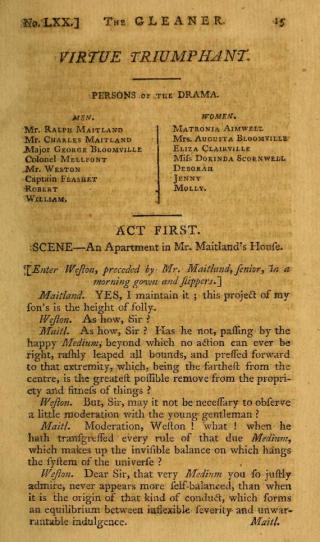
In 1798, she published “The Gleaner’s” collected columns. To ensure a profit, Murray recruited 800 presale “subscribers,” along with endorsements from President Washington and Vice President John Adams (The Sargent House Museum).
Later Life and Legacy
Murray put her words into action regarding women’s education in her later life and career. In 1802, Murray helped her cousin, Judith Saunders, and Clementine Beach open a female academy, the Saunders and Beach Academy, in Dorchester, south of Boston. However, Murray’s financial strain worsened after J. Murray suffered a stroke in 1809. After his death in 1815, she then moved to the frontier town of Natchez, Mississippi to live with her married daughter. Murray died there at age 69. Her letter books were discovered at a nearby Natchez plantation 164 years later (The New York Historical).
 Primary Source Analysis Strategies

On the Capabilities of Women from The New York Historical: A comparison of Judith Sargent Murray’s “On the Equality of the Sexes” and Virginia Randolph Carey’s Letters on Female Character, Addressed to a Young Lady on the Death of Her Mother.
-
What is Murray’s argument regarding the limitations facing women in the late 18th century? What causes women’s lack of social and political equality in her society, in her opinion?
-
What is Carey’s opinion on women’s political engagement? What are her reasons for the argument she makes?
-
What do these two texts reveal about the debate regarding women and politics in the Early Republic of the United States?
Federalist v. Anti-Federalist from The New York Historical: A comparison of Mercy Otis Warren’s “Observations on the New Constitution, and on Federal and State Conventions” and Judith Sargent Murray’s essay No. 87 from her series The Gleaner.
-
What is Warren’s argument against the ratification of the U.S. Constitution? Use her biography for context on her life and work if needed.
-
What is Murray’s argument in support of the U.S. Constitution? What social and political factors does she use to form her argument?
-
Both Warren and Murray were writing with pseudonyms, or fake names. Why do you think that was? What do you think it meant in the late 18th and early 19th century for women to write about current politics?
Constantia. “On the Equality of the Sexes”. Massachusetts Magazine. Boston: I. Thomas and E.T. Andrews, 1790. Vol. II. pgs. 132-135. Accessed June 9, 2026.
Burkhaugto, Kirstin. “Judith Sargent Murray and the Roots of American Feminism.” Interview with the Center for American Civics. November 18, 2025. https://www.youtube.com/watch?v=f83LcO-GDhc.
James, Janet Wilson. “Judith Sargent Murray” in James, Edward T., Janet Wilson James, Paul S. Boyer. Notable American Women: 1607-1950, A Biographical Dictionary. Cambridge: Belknap Press, 1971.
“Judith Sargent Murray.” The New York Historical. Accessed June 9, 2026. https://wams.nyhistory.org/life-story/life-story-judith-sargent-murray/.
“Judith Sargent Murray.” The Sargent House Museum. Accessed June 9, 2026. https://www.sargenthouse.org/judithsargent.
“Murray, Judith Sargent.” Shaping of America, 1783-1815 Reference Library. Lawrence W. Baker, et al., eds. Vol. 3: Biographies Volume 2. Detroit: UXL, 2006. 393-400. U.S. History in Context. Web. 9 Feb. 2015. Accessed January 10, 2015.
Murray, Judith Sargent. “Observations on Female Abilities,” from The Gleaner series, published 1798. Accessed online June 9, 2026 from the University of Oregon. https://pages.uoregon.edu/mjdennis/courses/history_456_murray3.htm.
Murray, Judith Sargent. “On the Equality of the Sexes.” First published in The Massachusetts Magazine, or, Monthly Museum Concerning the Literature, History, Politics, Arts, Manners, Amusements of the Age, Vol. II - For 1790. Accessed online June 9, 2026, from the University of Pennsylvania. https://digital.library.upenn.edu/women/murray/equality/equality.html.
Skemp, Sheila L. “Judith Sargent Murray and the Declaration of Indpeendence.” History Now, Issue 69 (Winter 2023). Accessed Online through The Gilder Lehrman Institute of American History, June 9, 2026. https://www.gilderlehrman.org/history-resources/essays/judith-sargent-murray-and-declaration-independence.
Smith, Bonnie Hurd. “Judith Sargent Murray”. Dictionary of Unitarian and Universalist Biography. Unitarian Universalist History & Heritage Association. Accessed January 10, 2015.
Weatherford, Doris. American Women’s History: An A to Z of People, Organizations, Issues, and Events. New York, NY: Patience Hall General Reference, 1994.
MLA — “Judith Sargent Murray.” National Women's History Museum. National Women's History Museum, 2015. Revised 2026. Date accessed.
Chicago — “Judith Sargent Murray.” National Women's History Museum. 2015. Revised 2026. www.womenshistory.org/education-resources/biographies/judith-sargent-murray.
Web Sites
The Judith Sargent Murray Society
Judith Sargent Murray Biography
Books
Cowell, Pattie ed. Women Poets in Revolutionary America 1650-1775: An Anthology. Troy: Whitston Publishing, 1981.
Field, Vena Bernadatte. Constantia: A Study of the Life and Works of Judith Sargent Murray, 1751-1820. Orono, Maine: University Press, 1931.
Harris, Sharon M., ed. Selected Writings of Judith Sargent Murray. New York: Oxford University Press, 1995.
James, Janet Wilson. “Judith Sargent Murray,” in Notable American Women, 1607-1950, Volume Two. Cambridge: Harvard University Press, 1971.
Kerber, Linda K. Women of the Republic: Intellect & Ideology in Revolutionary America. New York: W.W. Norton & Company, 1980.
Judith Sargent Murray. The Gleaner, with an introductory essay by Nina Baym. Schenectady, NY: Union College Press, 1992.
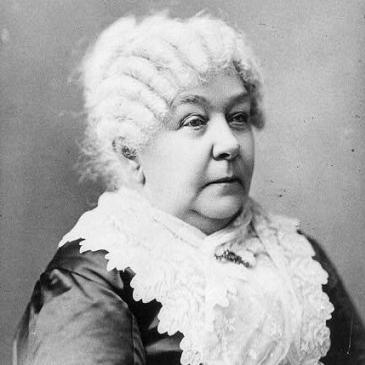
Elizabeth Cady Stanton
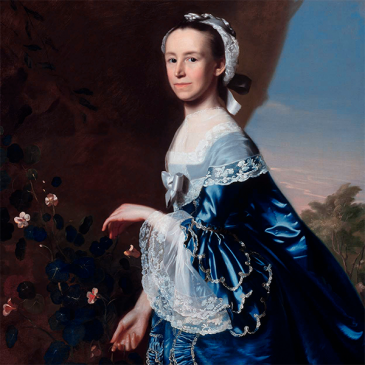
Mercy Otis Warren
Abigail Smith Adams