
Blending Sounds, Breaking Barriers
Grade Level
6th • 7th • 8th
Big Idea
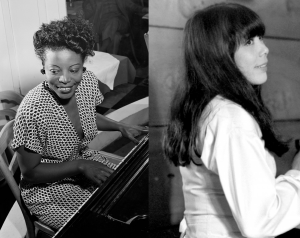
Women who redefined American jazz and broke societal barriers.
- Jazz sample listening warm up.
- History of Jazz webquest to learn about the history and cultural and societal influences of jazz.
- History of Music Genre tree.
Guiding Questions
- In what ways did Toshiko Akiyoshi and Mary Lou Williams transform the sound and development of jazz?
- What barriers did these women face in their careers, and how did they overcome them?
- How does jazz reflect broader social and cultural changes in American history?
45-60 minutes
- Explain how jazz developed as a uniquely American music genre influenced by diverse cultures.
- Identify contributions of Toshiko Akiyoshi and Mary Lou Williams to jazz composition and performance.
- Analyze how gender and cultural identity shaped the careers and music of these artists.
- Interpret primary sources (recordings, interviews, photographs) to understand historical context.
- Reflect on jazz’s role in shaping American culture and society.
Vocabulary
- Jazz
- Big Band
- Bebop
- Improvisation
- Arrangement
- Cultural fusion
Biographical Articles
Primary Sources
Jazz Resources (found in Webquest)
- National Museum of American History: “What is Jazz?”
- History of Jazz Timeline
- What are the Different Types of Jazz Music?
- National Museum of American History: “Groovin’ to Jazz (Ages 8-13)”
Mary Lou Williams
- Mr. Rogers Neighborhood: Mary Lou Williams (piano) and Milton Suggs (bass) May 2, 1973 Ep 1313 (also found in Webquest)
- The Mary Lou Williams Foundation
- Library of Congress: Mary Lou Williams: Jazz, Race, Gender, and Iconography
Toshiko Akiyoshi
-
LoC photograph: Swing Session (also found in Webquest)
-
Transcript: Smithsonian Oral History Interview (also found in Webquest)
-
Berklee Archives: Toshiko Akiyoshi, 2007 September 29
Music clips played by Akiyoshi & Williams
-
Long Yellow Road by Akiyoshi
-
Zodiac Suite (entire album) by Williams
Hook/Warm Up
Play two clips of music for students:
- Long Yellow Road by Akiyoshi
- Zodiac Suite*by Williams
*Pick one track from the album.
Ask students to write or discuss with each other:
- How does it feel to listen to each piece of music? Write down three adjectives to describe each piece.
- How does this music sound similar or different to other styles you know?
History of Jazz Webquest
Distribute the History of Jazz Webquest ideally by posting to a learning management site like Google Classroom. You may also choose to print copies of the webquest for each student and post the links alone. There are several listening and video components to the webquest so students will need headphones.
The teacher key for the webquest can be found here.
Summarizer
- Display the Mary Lou Williams History of Jazz tree with students. Williams drew out this tree herself with branches representing different styles of jazz and leaves representing significant figures who contributed to that genre. Ask students if they recognize any names on the tree.
- Provide students with the History of Music Genre tree and have them research their favorite music genre. Each branch should represent a different style or subgenre, and each leaf should feature a key figure who contributed to that style.
- Example: if the trunk is labeled Pop Music, the branches might include Traditional Pop, Rock and Roll, and Teen Pop. On the Traditional Pop branch, the leaves could feature artists like Frank Sinatra, Peggy Lee, and Billie Holiday.
- The PDF includes two versions of the tree: one is a simplified version for shorter time frames or additional support, and the other is a more detailed version for extended or more advanced work.
- The point of this exercise is for students to see how older genres of music contributed to the music they listen to today.
Assessment/Homework
- History of Jazz Webquest
- History of Music Genre Tree
Modification ideas
To accommodate IEPS, 504s, etc.
-
The History of Music Genre tree includes two versions of the tree: one is a simplified version for shorter time frames or additional support, and the other is a more detailed version for extended or more advanced work (low floor-high ceiling model).
- Break up the webquest into group work or only necessary components.
Extension activities
- Complete the Focused Inquiry: Did the Radio Make Jazz Better? from PBS.
- Create a jigsaw activity in which students become a “master” at one of the subgenres of jazz and then present to the class/small groups.
- Students investigate the role of jazz in the Civil Rights Movement.
- Students create their own piece of jazz in the style of one of the subgroups.
- Consider integrating the use of children’s literature with The Little Piano Girl: The Story of Mary Lou Williams, Jazz Legend by Ann Ingalls and Maryann Macdonald. This text does a good job of explaining how Mary Lou Williams was a natural at the piano and the racism she faced throughout her life.
Options for Incorporating Dimension 4
Taking Informed Action of the C3 Framework
- Curate a Jazz/Music Tribute Showcase: Students create a bio of a famous jazz musician (of their choosing or randomly assigned). Put on a showcase for students to highlight their contributions. Artists could be entirely women or an equal blend of men and women.
- Advocate for Representation in Music Curriculum: Students write a brief opinion piece, email, or social media post advocating for more women in jazz to be included in music or history classes. Students may present the school’s administration or school board with their written piece.
- Potential Prompts
- Why is it important to study musicians like Williams and Akiyoshi?
- How does knowing their stories change your view of American music?
- What could schools do to better represent women in jazz?
- Potential Prompts
Reflection and Teacher Notes
Please be aware that technology is an important component of this lesson.
C3 Standards
- D2.His.2.6-8. Classify series of historical events and developments as examples of change and/or continuity.
- D2.His.15.6-8. Evaluate the relative influence of various causes of events and developments in the past.