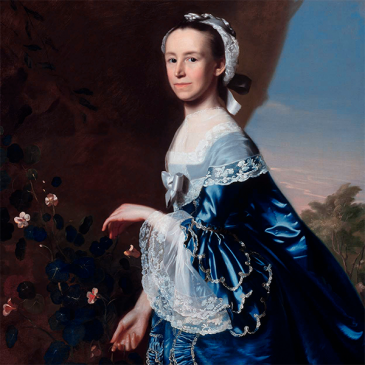
Abigail Smith Adams
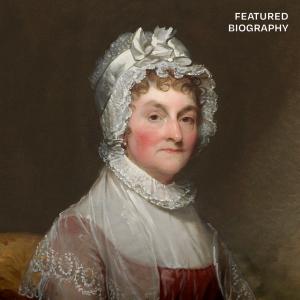
Making women’s needs visible to the Founding Fathers and asking that they “remember the ladies” in their new laws, Abigail Adams was an early advocate for women’s education and political engagement.
During John Adams’ prolonged absences from the family farm, Abigail Adams served as a deputy husband, managing the farm and developing innovative businesses to survive wartime conditions.
As First Lady, Abigail Adams was a vital confidant and advisor to her husband John Adams, the nation’s second president.
“I desire you would Remember the Ladies and be more generous and favorable to them than your ancestors. Do not put such unlimited power into the hands of the Husbands. Remember all Men would be tyrants if they could. If particular care and attention is not paid to the Ladies, we are determined to foment a Rebellion and will not hold ourselves bound by any Laws in which we have no voice, or Representation.”
Abigail Adams in a letter to John Adams, March 31, 1776
Early Life and Education
Abigail Smith was born to a prominent family in Weymouth, Massachusetts on November 22, 1744. Adams’ father, Reverend William Smith, was part of a prestigious ministerial community within the Congregational Church. When Abigail Smith was a child, New England schools were exclusively for boys, and girls received the basic instruction required to be a lady in society at home, such as reading, writing, and basic arithmetic. She was not satisfied with this and often lamented that she did not have the chance to pursue formal education, but she did grow up have a liberal father with a large library who encouraged her to follow her curiosity and read all that she could. Her male family members encouraged her education as well, such as her cousin Isaac who shared books with her as he prepared for Harvard, and her brother-in-law Richard Cranch who taught her French.
Marriage and Letters to John Adams
In 1764, at 20 years old, Abigail Smith married John Adams, an up-and-coming Harvard graduate beginning a law career. The couple moved to Adams’ farm that he had inherited from his father in Braintree, south of Boston. Their first daughter, Abigail, called “Nabby,” was born in 1765, followed by her son John Quincy Adams in 1767, who would later become President. In the following years, Abigail Adams would give birth to Susanna, who would die in infancy, Charles, and Thomas. John Adams began to travel in the court circuit, working in districts across the country. These frequent absences in their early years of marriage were a prelude to the prolonged separation his work during the American Revolutionary War would bring. The family moved to Boston to be closer to John Adams’ work. In Boston, their social circle would include Samuel Adams, John Hancock, James Otis, and Joseph Warren, all of whom would make major contributions to the American Revolution. Here, the couple faced their first major crises, following the Boston Massacre on March 5, 1770, when John Adams risked his career to defend the eight British soldiers and their captain accused of murdering five American colonists. He won the case, despite protests and accusations of betrayal from his fellow patriots.
In 1774, John Adams went to Philadelphia as a delegate to the First Continental Congress. Abigail Adams remained on the family farm. During the absence of her husband, she managed their farm and business affairs while raising the children. Although married women at this time had limited property rights, Adams began to refer to their property as hers. She also made investment decisions that enhanced the family’s prosperity. Her only contact with her husband was through letters, through which she documented her daily life, discussed intellectual matters, and reported on British military operations around Boston. Adams reports witnessing the Battle of Bunker Hill on June 17, 1775.
From their earliest married days, the couple began an extensive correspondence, especially when he traveled as a lawyer, which provides insight into the social and political climate of the Revolutionary and Early National periods in American history.
Correspondence and “Remember the Ladies” Letter
Letter writing was of particular importance to Abigail Adams throughout her life, and she regarded it to be a creative outlet as much as a form of communication. It was an activity she would partake in between household duties or at the end of the day after her children had gone to sleep. As she wrote to John Adams in 1781, “Here are particular times when I feel such an uneasiness, such a restlessness, as neither company, Books, family Cares of any other thing will remove, my Pen is my only pleasure and writing to you the composure of my mind.”
In 1776, as her husband participated served as a delegate for Massachusetts in the First Continental Congress in Philadelphia, Adams wrote her most famous letter that, in crafting documents such as the Declaration of Independence, John Adams and his contemporaries “remember the ladies.”
“I desire you would Remember the Ladies and be more generous and favorable to them than your ancestors. Do not put such unlimited power into the hands of the Husbands. Remember all Men would be tyrants if they could. If particular care and attention is not paid to the Ladies, we are determined to foment a Rebellion and will not hold ourselves bound by any Laws in which we have no voice, or Representation.”
Abigail Adams in a letter to John Adams, March 31, 1776
Echoing the same sentiment that the Founding Fathers used to justify their fight for independence from Great Britain, Abigail Adams argued that women would not follow laws in which they were not represented. Despite her more equal marriage with her husband, under the standards of time, she realized women’s rights to life, liberty, and the pursuit of happiness, could not be granted on a case-by-case basis from willing husbands. She lived under the laws of coverture, meaning that she as a married women had no legal distinction from her husband and had no right to her own property or money. She was concerned with greater protection for women under the new laws, as well as access to formal education. She allied with Judith Sargent Murray’s efforts to expand women’s education because Adams, too, was a proponent of Republican Motherhood. In particular, she believed that mothers had a vital role in political life and needed to be engaged in politics in order to prepare their sons to be virtuous citizens and leaders in the new republic. As she wrote to John Adams on June 17, 1782:
“Excluded from honours and from offices, we cannot attach ourselves to the State or Government from having held a place of Eminence. Even in the freeest countrys our property is subject to the controul and disposal of our partners, to whom the Laws have given a soverign Authority. Deprived of a voice in Legislation, obliged to submit to those Laws which are imposed upon us, is it not sufficient to make us indifferent to the publick Welfare?”
Abigail Adams to John Adams, June 17, 1782
As the American Revolution progressed, John Adams was sent to France in 1778 to negotiate an alliance. This would be a deciding factor in the outcome of the war. He remained abroad for the rest of the war, only occasionally visiting home, successfully forming an alliance with France and serving as a diplomat in at the court of Versailles. Abigail Adams remained at the farm and often describes in her letters to her husband the struggle to run the farm, get the goods the family needed amongst war shortages, and educate their children. As she wrote to John Adams on December 27, 1783, she found the responsibilities to be overwhelming:
“If my dear Friend you will promise to come home, take the Farm into your own hands and improve it, let me turn dairy woman, and assist you in getting our living this way; instead of running away to foreign courts and leaving me half my Life to mourn in widowhood, then I will run you in debt for this Farm.”
Abigail Adams to John Adams, December 27, 1783
She often suffered from loneliness, especially when her son John Quincy Adams joined his father in France. As she wrote to John Adams on December 27, 1778, “How lonely are my days? How solitary are my Nights? Secluded from all Society but my two Little Boys, and my domestics, by the Mountains of snow which surround me I could almost fancy myself in Greenland.”
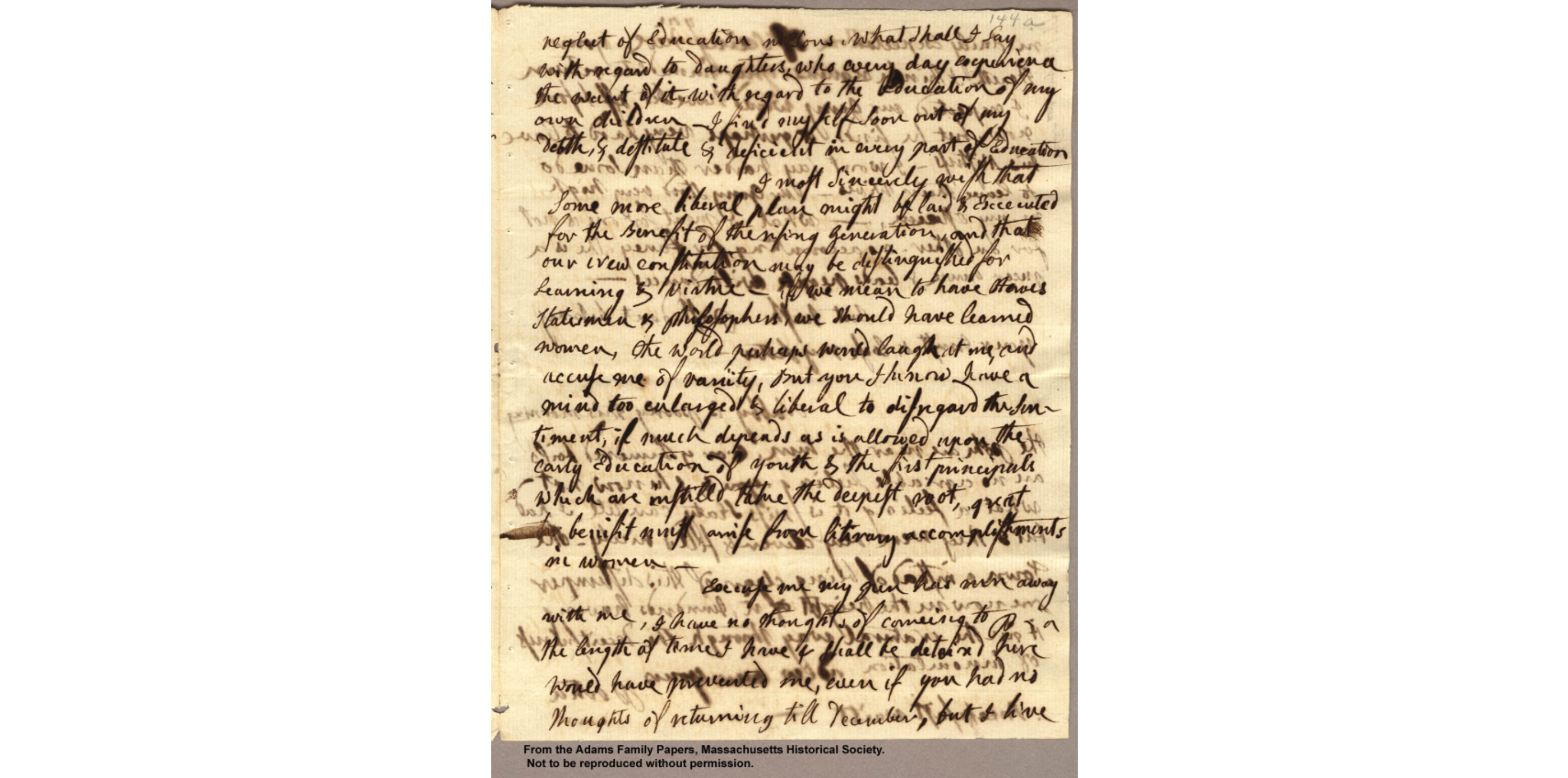
Letter from Abigail Adams to John Adams, 14 August, 1776
“If you complain of neglect of Education in sons, What shall I say with regard to daughters, who every day experience the want of it....If we mean to have Heroes, Statesmen and Philosophers, we should have learned women. The world perhaps would laugh at me, and accuse me of vanity, But you I know have a mind too enlarged and liberal to disregard the Sentiment. If much depends as is allowed upon the early Education of youth and the first principals which are instilled take the deepest root, great benefit must arise from literary accomplishments in women.”
Letter from Abigail Adams to John Adams, 14 August, 1776
She also gained confidence in her abilities in this period and expressed her views frankly to her husband and to her friends. Managing the business affairs of her family, such as profitable war bond trading and a small European good-importation business, including the list of items, such as “Gauze hankerchiefs (the best articles imported)” and “low-priced calicos” that she requested from Holland in her June 17, 1782 letter to her husband. She even made property transactions that John Adams explicitly disapproved of, buying farmland in Vermont that she intended to be their home when he returned from Europe. When the war ended in 1783, and John Adams was appointed to be the first United States minister to Great Britain, Abigail Adams made a decision to take a journey that she feared: to cross the Atlantic with her daughter. She traveled with him throughout Europe for five years (1783-1788), before they returned to Braintree, Massachusetts.
First Lady Abigail Adams
When John Adams became the first Vice President of the United States in 1789, Abigail Adams moved with him to Philadelphia to support his work. She frequently entertained and held weekly dinners, making their home a space of both political discourse and connection. The lifelong influence Abigail Adams had on her husband’s political career was clear when Adams eagerly wrote to his wife after his election to be second President of the United States in 1797, “I never wanted your Advice and assistance more in my life…” An outspoken First Lady, in contrast to the more quiet presence of Martha Washington, Adams often defended her husband’s positions in her correspondence, including his advocacy of the controversial Alien and Sedition Acts (1798). She was well informed on political issues and often acted as an intermediary to her husband, with many contacting Abigail Adams herself in order to reach her husband faster. She also promoted his reputation by planting favorable stories in the press. She often suffered from ill health while John Adams was President and frequently retreated to the farm in Braintree to recover from rheumatism. Despite these pitfalls, she was an active in her duties as First Lady, which included receiving official state guests and informally campaigning for support for her husband’s policies at social events and through correspondence.
Later Life and Legacy
When Adams lost his re-election bid in 1800, the couple returned to Massachusetts. Abigail Adams was active in her family, often entertaining her grandchildren, nieces, and nephews, and supporting their advancement in society. Finally surrounded by her loved ones, she prospered in the peace of her home, visiting friends, reading voraciously, and always writing. Abigail maintained correspondence with political leaders including presidents Thomas Jefferson and James Madison, as well as Dolley Madison. She died on October 28, 1818.
Her grandson, Charles Francis Adams published Abigail Adams’ letters in 1848. Abigail Adams remains an iconic figure in history of women in the American Revolution, especially for her “Remember the Ladies” letter. Beyond that famous letter, she advised her husband throughout his political career, especially as an active First Lady of the United States. Her letters also reveal a woman that single-handedly managed her family affairs during wartime and was unafraid to express her true opinions on politics and on society despite a culture which would have preferred her silence. Her legacy survives in not only the letters she wrote, but the numerous institutions which honor her, such as the Adams National Historical Park and Abigail Adams Birthplace.
 Primary Source Analysis Strategies

-
Read Abigail Adams’ letter to John Adams from March 31, 1776, which contains her most often quoted “Remember the Ladies” letter. Before focusing on that paragraph, what do you note about Adams’ other daily concerns that she expresses in this letter? What challenges does she face in the absence of John Adams, living during a war? How does she approach finding solutions to these problems?
-
Now focusing on the paragraph which contains the “Remember the Ladies” passage, how would you describe Adams’ view on women’s place in society? In what particular modes does she desire change? What are her reasons for this?
-
Would you call Adams’ words “progressive” or even “feminist”? Why or why not?
Letter regarding Women’s Education
-
Read Abigail Adams’ letter to John Adams from August 14, 1776, particularly focusing on the paragraphs where she describes her view on women’s education.
-
Why does Adams think women’s education is important?
-
What arguments does she use to support her view?
American Experience. “Biography: Abigail Adams.” Pbs.org. Accessed May 22, 2026. https://www.pbs.org/wgbh/americanexperience/features/adams-abigail/
Crane, Elaine Forman. “Abigail Adams, Gender Politics, and ‘The History of Emily Montague’: A Postscript.” The William and Mary Quarterly 64, no. 4 (2007): 839–44.
Crane, Elaine Forman. “Political Dialogue and the Spring of Abigail’s Discontent.” The William and Mary Quarterly 56, no. 4 (1999): 745–74
Gelles, Edith B. “Abigail Adams: Domesticity and the American Revolution.” The New England Quarterly 52, no. 4 (1979): 500–521.
Gelles, Edith B. “Bonds of Friendship: The Correspondence of Abigail Adams and Mercy Otis Warren.” Proceedings of the Massachusetts Historical Society 108 (1996): 35–71. http://www.jstor.org/stable/25081114.
Holton, Woody. “Abigail Adams, Bond Speculator.” The William and Mary Quarterly 64, no. 4 (2007): 821–38. http://www.jstor.org/stable/25096751.
Letter from Abigail Adams to John Adams, 14 August 1776 [electronic edition]. Adams Family Papers: An Electronic Archive. Massachusetts Historical Society. http://www.masshist.org/digitaladams/
Letter from John Adams to Abigail Adams, 22 March 1797 [electronic edition]. Adams Family Papers: An Electronic Archive. Massachusetts Historical Society. http://www.masshist.org/digitaladams/
Letter from Abigail Adams to John Adams, 31 March - 5 April 1776 [electronic edition]. Adams Family Papers: An Electronic Archive. Massachusetts Historical Society. http://www.masshist.org/digitaladams/
Mieder, Wolfgang. “‘God Helps Them Who Help Themselves’: Proverbial Resolve in the Letters of Abigail Adams.” In Proverbs Are The Best Policy: Folk Wisdom And American Politics. University Press of Colorado, 2005
National Parks Service. “Abigail Adams.” NPS.gov. Accessed May 22, 2026. https://www.nps.gov/adam/learn/historyculture/abigail-adams-1744-1818.htm?fbclid=IwAR2RVIVqYkZQodRvXXEICQV9eLz_zas2xw2b71ySXm05511nBiUelHXHhNI
O’Connor, Karen, Bernadette Nye, and Laura Van Assendelft. “Wives in the White House: The Political Influence of First Ladies.” Presidential Studies Quarterly 26, no. 3 (1996): 835–53. http://www.jstor.org/stable/27551636.
University of Virginia. “Abigail Adams.” Miller Center at UVA. Accessed May 22, 2026. https://millercenter.org/president/adams/adams-1797-abigail-firstlady
MLA — “Abigail Adams.” National Women’s History Museum. National Women’s History Museum, 2015. Revised 2026. Date accessed.
Chicago — “Abigail Adams.” National Women’s History Museum. 2015. Revised 2026. www.womenshistory.org/education-resources/biographies/abigail-smith-adams.
Web Sites
Letters Between Abigail Adams and John Adams, Biography, and Timeline
Massachusetts Historical Society, Digitized Correspondence between John and Abigail Adams
Abigail Adams Birthplace Museum
Books
Adams, Abigail. The Book of Abigail and John: Selected Letter of the Adams Family, 1762-1784. Cambridge, MA: Harvard University Press, 1975.
Adams, Charles Francis. Familiar Letters of John Adams and His Wife Abigail Adams During the Revolution. New York: Penguin Books, 2004. (originally printed in 1875 in Boston)
Adams, John. The Adams-Jefferson Letters: The Complete Correspondence Between Thomas Jefferson and Abigail and John Adams. Two Volumes. Chapel Hill: University of North Carolina, 1959.
Akers, Charles W., Abigail Adams: An American Woman. Boston: Little, Brown & Company, 1980.
Gelles, Edith B., Portia: The World of Abigail Adams. Bloomington: Indiana University Press, 1992.
Nagel, Paul C. The Adams Women: Abigail and Louisa Adams, Their Sisters and Daughters.
New letters of Abigail Adams, 1788-1801. Ed. Stewart Mitchell. Boston, Houghton Mifflin Co., 1947.
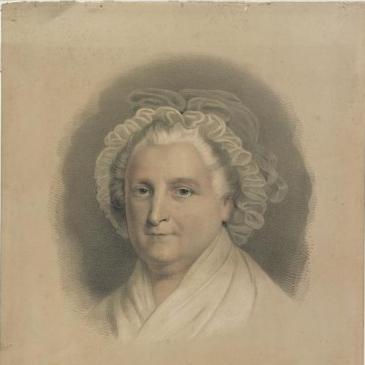
Martha Washington
Mercy Otis Warren