Beyoncé Knowles-Carter
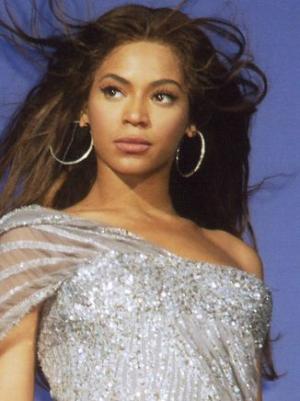
Beyoncé is the most decorated and nominated artist in GRAMMY history, with 99 nominations and 35 wins.
Beyoncé has built her career on continuing Black musical traditions and excellency, especially elevating Black women’s stories. From her performance in Destiny’s Child to her most recent three-album musical reclamation project, Beyoncé’s career is rooted in her respect for Black cultural and musical history.
As a Black woman artist, performer, businesswoman, and mother, Beyoncé’s story reminds us of the humanity behind our biggest stars that is complicated by a desire to overcome barriers to success.
“I don’t want calling myself a feminist to make it feel like that’s my one priority, over racism or sexism or anything else... If you believe in equal rights, the same way society allows a man to express his darkness, to express his pain, to express his sexuality, to express his opinion—I feel that women have the same rights.”
Beyoncé, Interview with Elle
Early Life
Beyoncé Giselle Knowles was born in Houston, Texas on September 4th, 1981, to mother Tina Knowles, a hairdresser and fashion designer, and father Mathew Knowles, an entertainment executive. Her parents, both entrepreneurs, worked hard to provide a comfortable upbringing for Beyoncé and her younger sister, Solange. Tina and Mathew both pushed and supported Beyoncé to follow her dreams and taught her that “nothing worth having comes easy” (Elle).
Beyoncé was enrolled in dance classes at around seven years old and began singing in local choirs and talent shows throughout the Houston area (Teach Rock). Her passion for performing launched her early career when she auditioned for a girls R&B group in 1992. The original group, which included Kelly Rowland and LaTavia Robinson, would eventually be known as Girls’ Tyme. Beyoncé’s father managed the group, booking performances around Houston and restructuring the group to include LeToya Luckett. Girls’ Tyme is an early step in Beyoncé’s lifetime of continuing Black musical traditions through her work. By performing in a Black girl group, she carried on the legacy of 1960s girl groups such as The Supremes and The Marvelettes.
Destiny’s Child
Girls’ Tyme became Destiny’s Child when the group signed onto Columbia Records in 1996. Destiny’s Child released their first album, Destiny’s Child, shortly followed by their second album, The Writing’s on the Wall. Both albums were major successes, and The Writing’s on the Wall became an 8x platinum record and spent 99 weeks on the Billboard 200 chart. However, internal tensions during the The Writing’s on the Wall era resulted in more restructuring of the group: Robinson and Luckett were replaced by Farrah Franklin and Michelle Williams. Within a year, Franklin was also dismissed from the group, leaving the iconic trio Beyoncé, Kelly, and Michelle.
As the lead vocalist, Beyoncé was placed front and center of Destiny’s Child. Some attribute this to favoritism from Beyoncé’s father as the group’s manager. Others, however, attribute Beyoncé’s role in Destiny’s Child to her undisputable talent, work ethic, and commitment to the group’s success. Her increased role in producing the Survivor album demonstrates this unmatched dedication.
Figure 1. Interview with MTV News to discuss Survivor, Destiny’s Child’s third studio album.
Beyoncé the Solo Artist
Following the major success of Survivor, Beyoncé began to pursue solo opportunities in both music and acting. Between 2001 and 2003, Beyoncé starred in three films: Carmen: A Hip Hopera (2001), Austin Powers: Goldmember (2003), and The Fighting Temptations (2003). She also released her first solo studio album, Dangerously in Love, in June of 2003. This album included the hit “Crazy in Love,” featuring Beyoncé’s future husband, Jay Z. Beyoncé would go on to win five Grammy’s for the album—Beyoncé’s first solo Grammy awards—including Best Contemporary R&B Album (GRAMMY Awards). “Crazy in Love” was nominated for Record of the Year.
Even with the success of her solo career, Beyoncé was not quite finished with Destiny’s Child. The group released their final studio album, Destiny Fulfilled, in 2004 and embarked on their final world tour together in 2005. Destiny’s Child officially disbanded in 2006. Through her time in Destiny’s Child, Beyoncé set her stage for a lifetime of musical excellence and artistry. She laid the groundwork for a commitment to furthering Black musical traditions that would carry throughout her career. Beyoncé continues to acknowledge the importance that the group had on her early career and has reunited the group for one-off performances throughout her solo career.
After Destiny’s Child disbanded, Beyoncé continued with her legendary solo career. Her second solo album, B’Day, was released on Beyoncé’s 25th birthday in 2006. B’Day debuted at number 1 on the Billboard 200, received four GRAMMY nominations, and won one GRAMMY for Best Contemporary R&B Album.
In December of 2006, Beyoncé starred as Deena Jones in the drama film Dreamgirls, based loosely on The Supremes. Beyoncé's performance was partially inspired by her experience in Destiny’s Child. In addition, Beyoncé’s commitment to understanding Black music history guided her performance. Though she received numerous nominations for her performance, including two Golden Globe nominations, she herself did not win any.
Beyoncé’s third album I AM...SASHA FIERCE, released in 2008, was another hit. The album’s title refers to Beyoncé’s alter ego, Sasha Fierce, who Beyoncé created to“help her overcome challenges and give the best performances she can” (Oprah). The confident, stage-owning alter ego of Sasha Fierce differs from the shy Beyoncé, and the album provides a lens into both the persona and Beyoncé’s own vulnerability. It included ballads “Halo” and “If I Were a Boy,” as well as the iconic dance track “Single Ladies (Put a Ring on It).” The album also debuted at number 1 on the Billboard 200, and Beyoncé won her third consecutive Best Contemporary R&B Album award at the 2010 GRAMMYs.
Beyoncé began building her business empire in 2010 when she established Parkwood Entertainment and moved much of her work in-house (Forbes). From producing music, documentaries, and concerts, Parkwood fronts the front-end production costs and reaps the back-end economic gains. Beyoncé cites Madonna as an inspiration to take control of her own work:
“I felt like I wanted to follow the footsteps of Madonna and be a powerhouse and have my own empire and show other women when you get to this point in your career you don’t have to go sign with someone else and share your money and your success—you do it yourself.”
Beyoncé
Parkwood has now expanded to include Beyoncé’s smaller endeavors, including Cecred, a hair care brand, Sir Davis Whiskey, a whiskey label, and Ivy Park, a now-discontinued clothing line. Despite this growth, Beyoncé continues to make the majority of her wealth from her music and tours (Forbes).
Beyoncé’s fourth album, appropriately named 4, was released in 2011. Beyoncé promoted the album through a performance at the 2011 VMAs, where she also announced her pregnancy with her first daughter, Blue Ivy Carter. Beyoncé’s motherhood, though separate from her musical talents, would become a key element of Beyoncé’s artistry and legacy as a Black woman artist. As she has shared, “Something cracked open inside of me right after giving birth to my first daughter. From that point on, I truly understood my power, and motherhood has been my biggest inspiration.” (PopSugar).
Beyoncé credited Blue Ivy in the writing of “Brown Skin Girls,” a song celebrating young Black girls that would win Blue Ivy a GRAMMY at only 9 years old. Additionally, Beyoncé invited Blue Ivy to perform on both the Renaissance and Cowboy Carter World Tours, beginning at the age of 11. Beyoncé’s commitment to continuing Black legacies is seen in her own relationship to Blue Ivy and motherhood.
4 also included the song “Who Run The World (Girls),” an uplifting song speaking to the foundational role that women play in society and culture. Though the song was criticized by contemporary listeners for “proffering post-feminist falsehoods,” it is regarded today as a very important feminist anthem for the ways in which it seems to address how patriarchy “runs” on women’s reproductive and capitalist labor, care work, and accomplishments (James).
Figure 3. “Who Run The World (Girls)” music video.
Beyoncé performed the national anthem at President Barack Obama’s second inauguration in 2013, further uplifting Black excellence through her artistry. She also headlined the Superbowl XLVII halftime show in 2013. When Beyoncé surprise-released her self-titled album at the end of 2013, then, it is no shock that it was a massive commercial success.
Black Empowerment
2016 is often marked as a turning point in Beyoncé’s career. Her release of Lemonade, an album celebrating unapologetic Black womanhood, is attributed to a shift in Beyoncé’s artistic focus toward politics and her Black southern roots. Although this “shift” might be a useful way to frame Beyoncé’s art, Beyoncé’s career was built on a foundation of Black musical traditions and Black experiences. As explained, Destiny’s Child followed in the tradition of 1960s girl groups out of Motown. Beyoncé’s role in Dreamgirls required a historical appreciation of Black women’s contributions to music. Early songs in her career, including “Countdown,” make mention of her hometown, Houston, Texas. Beyoncé’s marriage to Jay-Z, one of the biggest hip-hop artists of the 21st century, marked one of the most important Black music cultural moments in modern history. Thus, while Lemonade as a product might mark a turning point, Beyoncé herself has been rooted in Black musical tradition since the start of her career. Lemonade has inspired countless articles and scholarship, including college courses, and is regarded as the number one album of the 21st Century so far by Rolling Stone.
After giving birth to twins Rumi and Sir Carter in 2017, Beyoncé returned to the spotlight to headline Coachella in 2018, the first Black woman artist to do so. Her performance centered Historically Black College and University (HBCU) culture, featuring a live marching band and dance squad. The performance was turned into a film titled Homecoming: A Film by Beyoncé, further drawing upon HBCU traditions, and released as a live album. Beyoncé also voiced Nala in the 2019 Disney live-action adaptation of The Lion King. She created an accompanying album for the film, The Lion King: The Gift, and visual album, Black is King, dedicated to her son Sir Carter. Both Coachella and Beyoncé’s involvement with The Lion King have demonstrated a heightened focus on Black culture, art, and history in Beyoncé’s career.
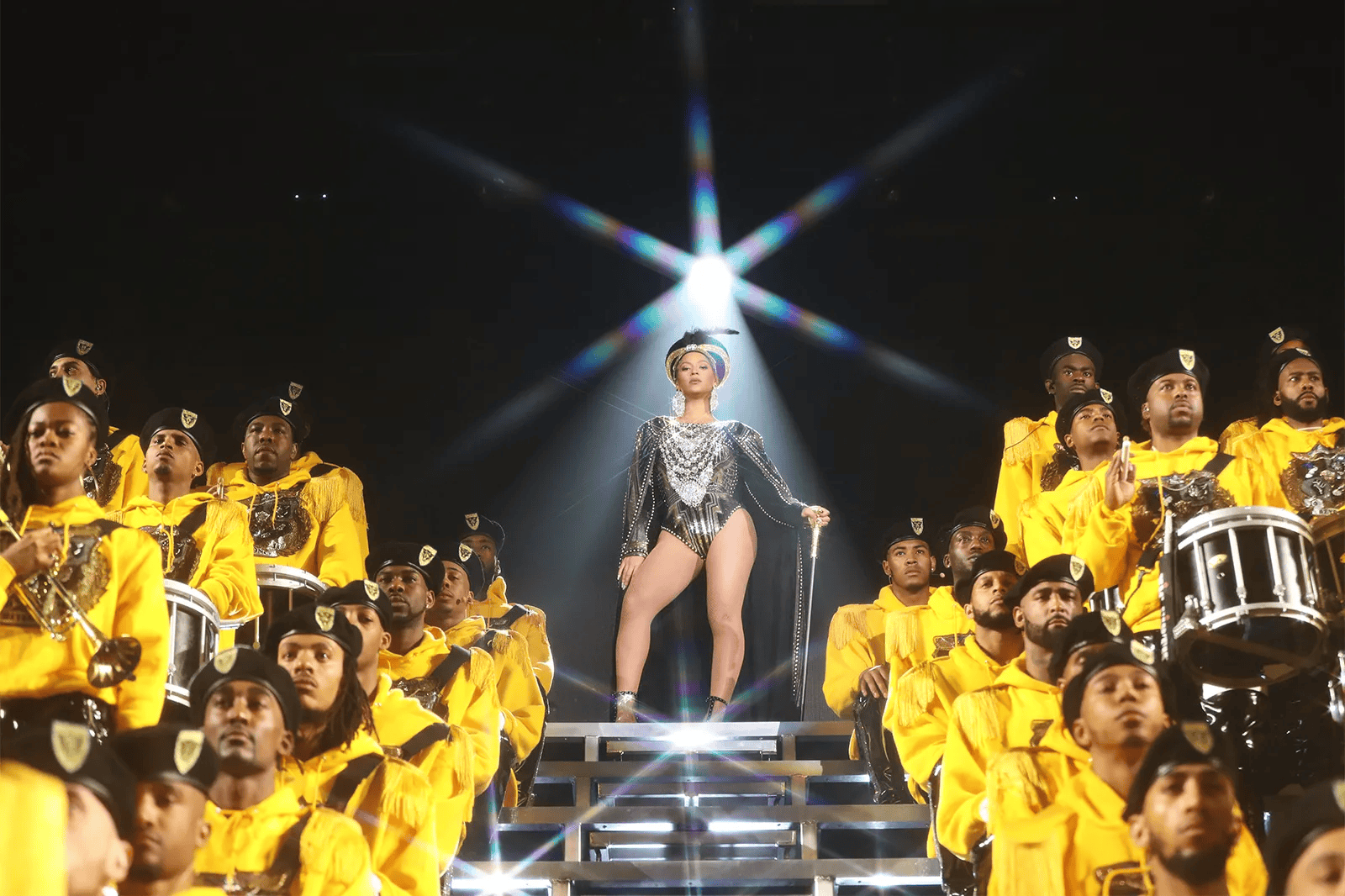
Figure 4. Beyoncé performing at Coachella in 2018. Her opening costume, as seen here, is inspired by Queen Nefertiti of Ancient Egypt. She is surrounded by members of renowned HBCU marching bands, drum lines, and majorettes. Photograph by Andrew White / Parkwood Entertainment.
Following Coachella, Beyoncé took a short break. This was, at least in part, because of the Covid-19 Pandemic. As she articulated in an interview with Vogue, “I’ve spent a lot of time focusing on building my legacy and representing my culture the best way I know how. Now, I've decided to give myself permission to focus on my joy” (PopSugar). Beyoncé returned to music in 2022 with the release of RENAISSANCE, the first of three albums in her musical reclamation project. RENAISSANCE addresses how house music, originally created by Black and brown queer communities, has been lost to white artists and audiences. The album effectively shines a light on this loss and has led to conversations on the reclaiming of house music for its originators. RENAISSANCE was nominated for eight GRAMMYs and won four.
The second album in the trilogy, COWBOY CARTER, does similar work of musical reclamation for country music. Beyoncé features Linda Martell, the first commercially successful Black woman country artist. She was the first Black woman to play the Grand Ole Opry (Linda Martell). Beyoncé also features rising Black country artists such as Tanner Adell, Reyna Roberts, Britney Spencer, Willie Jones, and Shaboozey. The album speaks to Black southern womanhood through vulnerability and empowerment, highlighting Beyoncé’s own experiences within the industry and how those relate to her personal identity. “16 CARRIAGES,” one of the lead singles from the album, directly addresses Beyoncé’s internal struggle between her ongoing pursuit of success at the cost of time with her family: “It’s been 38 summers, and I’m not in my bed/ on the back of the bus and a bunk with the band/ goin’ so hard, now I miss my kids/ overworked and overwhelmed” (Beyoncé). COWBOY CARTER was critically acclaimed, garnering 11 GRAMMY nominations and three wins. Notably, Beyoncé won her first Album of the Year award for COWBOY CARTER.
Beyoncé’s Legacy
Beyoncé is the most decorated and nominated artist in GRAMMY history, with 99 nominations and 35 wins. She has performed around the globe on her many world tours, headlined the Superbowl Halftime Show twice, headlined Coachella as the first Black woman to do so, sung at the 2013 Presidential Inauguration, and much more. She is an international musical phenomenon and true tour de force in the industry.
Beyoncé is not just a musical legend. She is also a wildly successful businesswoman. At the end of 2025, Beyoncé reached billionaire status, according to Forbes. She was the fifth musical artist to do so, behind Jay-Z, Taylor Swift, Bruce Springsteen, and Rihanna (Forbes).
Though her career had humble beginnings performing in talent shows around Houston, Beyoncé is an example of the power and beauty behind one’s commitment to making authentic art, connecting with your roots, and never forgetting that you are flawless. As a Black woman artist, performer, businesswoman, and mother, Beyoncé’s story reminds us of the humanity behind our biggest stars that is complicated by a desire to overcome systems that otherwise might inhibit success.
Beyoncé. “16 CARRIAGES (Official Visualizer).” Beyoncé, 2024.
https://www.youtube.com/watch?v=hhKNjTb6U1Y.
Beyoncé. “SVA Directors Screening + Instagram Q&A.” Beyoncé, 2014.
https://www.youtube.com/watch?v=x1KOSwReF2E.
Craig, Matt. “Beyoncé Is Now a Billionaire.” Forbes, 2026.
https://www.forbes.com/sites/mattcraig/2025/12/23/Beyoncé-is-now-a-billionaire/.
Cubit, Brea. “Beyoncé Opens Up About ‘Representing My Culture’ in Historic British Vogue Cover Story.” PopSugar, 2020.
https://www.popsugar.com/celebrity/Beyoncé-british-vogue-december-2020-47931807.
Donica, Adrienne and Catherine Caruso. “Beyoncé.” Biography, 2025.
https://www.biography.com/musicians/Beyoncé-knowles#quick-facts
Gottesman, Tamar. “EXCLUSIVE: Beyoncé́ Wants to Change the Conversation.” Elle, 2016. https://www.elle.com/fashion/a35286/Beyoncé-elle-cover-photos/.
GRAMMY Awards. “Beyoncé.” GRAMMY Awards, n.d.
https://www.grammy.com/artists/Beyoncé-knowles/12474.
James, Robin. “Girls do run the world, but patriarchy keeps that fact quietly bracketed: Listening to Beyoncé’s “Run the World (Girls).”” It’s Her Factory, 2011.
https://www.its-her-factory.com/2011/05/girls-do-run-the-world-but-patriarchy-keeps-that-fact-quietly-bracketed-listening-to-Beyoncés-run-the-world-girls/.
Jones, Remone, dir. “Beyoncé: Her Success Story | From Talent Show Underdog to Global Icon.” Fame, 2025. https://www.youtube.com/watch?v=6bB2YcjIkfE.
Keys, Jen. “Beyoncé Knowles performing “Listen” during “The Beyoncé Experience” in Munich, Germany.” https://commons.wikimedia.org/wiki/File:Beyoncé_cropped.jpg.
“Linda Martell.” Linda Martell, n.d. https://www.lindamartell.com/.
MTV News. “Destiny’s Child Discuss Their Inspiration for their Single, ‘Survivor’ (2001) | MTV News | #TBMTV.” MTV News, 2018.
https://www.youtube.com/watch?v=nQGJaZdnlaQ
Professor Wright. “Beyoncé’s Cowboy Carter and ‘Ya Ya’: A Reclamation of Country and Rock and a Challenge to Musical Appropriation and Theft.” Medium, 2025. https://theprofwright.medium.com/beyonc%C3%A9s-cowboy-carter-and-ya-ya-a-reclamation-of-country-and-rock-and-a-challenge-to-musical-d8c0ea18c183.
Rolling Stone. “The 250 Greatest Albums of the 21st Century So Far.” Rolling Stone, 2025. https://www.rollingstone.com/music/music-lists/best-albums-21st-century-1235177256/radiohead-kid-a-6-1235188695/.
Teach Rock. “Beyoncé.” Teach Rock, 2019.
https://teachrock.org/traceitback/Beyoncé/.
White, Andrew. “Beyoncé’s Coachella performance.” Parkwood Entertainment, 2018. https://www.newyorker.com/culture/culture-desk/Beyoncés-triumphant-homecoming-at-coachella.
Winfrey, Oprah. “Beyoncé is Sasha Fierce.” Oprah.com, 2008.
https://www.oprah.com/oprahshow/Beyoncés-alter-ego
MLA — “Beyoncé Knowles-Carter.” National Women’s History Museum, 2026. Date accessed.
Chicago — “Beyoncé Knowles-Carter.” National Women’s History Museum. 2026. https://www.womenshistory.org/education-resources/biographies/beyonce-knowles-carter.
Taraborrelli, J. Randy. Becoming Beyoncé: The Untold Story. New York: Grand Central Publishing, 2025.
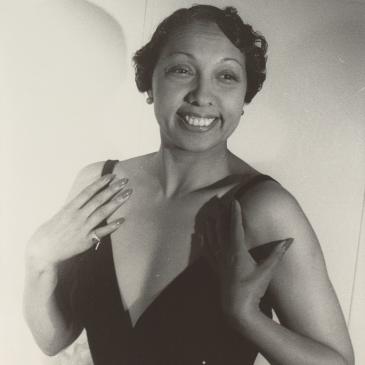
Josephine Baker
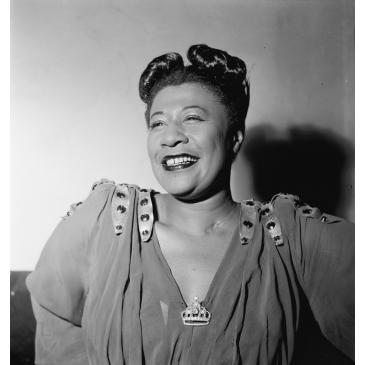
Ella Fitzgerald
Sister Rosetta Tharpe

This biography is sponsored in part by the Library of Congress Teaching with Primary Sources Eastern Region Program, coordinated by Waynesburg University. Content created and featured in partnership with the TPS program does not indicate an endorsement by the Library of Congress.
For further information or questions, please contact [email protected].
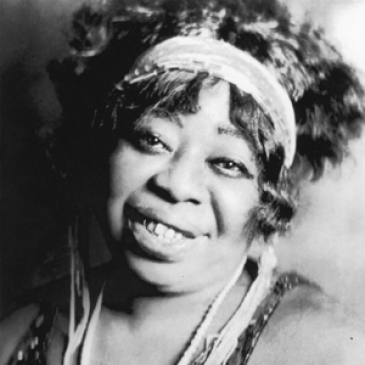
Gertrude “Ma” Rainey