
Gracia Molina de Pick
Summary
-
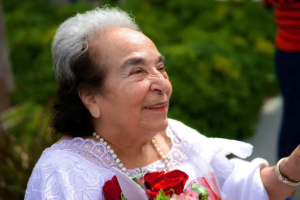
Gracia Molina de Pick is most known for her contributions to developing the Chicano(a) program at Mesa College in San Diego, the first of its kind to be established at a community college.
-
Gracia Molina de Pick was a fierce advocate for the rights and inclusion of the Hispanic community, particularly in the field of education.
-
Gracia Molina de Pick contributed to various social movements across her lifetime, from Mexican women’s suffrage in her youth to international labor movements in the 1970s, and beyond.
Quote
“I learned from them [my aunt and Frida Kahlo] that great people defend not only themselves, but those who cannot defend themselves... My last breath will be fighting for those human rights.” - Gracia Molina de Pick, San Diego Mexican and Chicano History.
Born into Activism
Gracia Molina de Pick was born Gracia Molina Enriquez on March 21, 1928, in Morelia, Michoacan in Mexico to a family of political reformers. Her grandfather, Andres Molina Enriquez was a “key intellectual in the Mexican Revolution, writing the first draft of the new constitution’s land reforms” (Wilkins, 2019). The Mexican Revolution was fought from 1910 to 1917 and rose from conflicts between political rivals who desired Mexican Presidency, power, and control. Her aunt was also good friends with Frida Kahlo, who de Pick remembered as central to the development of her own activist mindset: “I learned from them [her aunt and Frida Kahlo] that great people defend not only themselves, but those who cannot defend themselves... My last breath will be fighting for those human rights” (San Diego Mexican & Chicano History).
Born into this family and network of key political figures, de Pick found herself frequently surrounded by progressive ideals that demonstrated the importance of education, women’s rights, workers’ rights, and human rights internationally. In an interview with Veteran Feminists of America, Inc., de Pick shared that her earliest activism was at the age of 17, when she began helping women in Mexico gain the right to vote through helping organize and found Partido Popular, a Mexican political party that centered women’s suffrage (VFA). After ten years, women finally gained the right to vote in 1953. de Pick had already moved to the United States when Mexican women were able to vote in their first Presidential election in 1958, but her involvement in women’s suffrage as a teenager set her along a path of activism.
In 1946, when de Pick was 18, she took a trip to Paris, France to attend the founding congress of the International Union of Socialist Youth. This was an organization that had been evolving since 1907, but by the end of World War II, had shifted its focus “on supporting decolonisation efforts and struggles for independence, especially in Africa and Asia” (IUSY). While in Europe over the next couple months, she found herself behind the Iron Curtain in Yugoslavia helping rebuild the countries railroads alongside many other young people engaged in the global effort to protect human rights. Not much else is known about this time in de Pick’s life. Though she eventually returned to Mexico, de Pick’s early engagement with Mexican women’s suffrage and the youth socialist movement show how de Pick found activism and hands-on work critical to human rights.
From Activist to Activist-Educator
After returning to Mexico, de Pick met Richard Pick, whom she would marry and move to California with in 1957. Once in the United States, de Pick immediately got engaged in local and national politics. She was particularly involved within the Chicano(a) Movement, “the largest and most widespread civil rights and empowerment movement by Mexican-descent people in the United States” that began with the famous grape strike in California’s Central Valley in 1965 (Facing Ourselves and History). In California, she received her bachelor's and Master of Arts degrees in Spanish Language from San Diego State University. She pursued doctoral studies at University of California San Diego and University of Southern California in Education Administration, but it is unclear whether she received a PhD or Ed.D. de Pick’s pursuit of these degrees opened the door for her to work in education, an aspiration that persisted from her youth when she learned the importance of education in ensuring human rights.
Molina de Pick used her experience in education administration to directly contribute to the establishment of the country’s first associate's degree in Chicano(a) studies at Mesa College in 1970, an endeavor that remains one of de Pick’s most remembered and celebrated accomplishments. She would later gift an endowment of $80,000 in support of the Chicano(a) Studies Department at Mesa College, which is “believed to be the largest donation of its kind awarded to support a Chicano(a) Studies program at a community college” (San Diego Mesa Office of Communications). In recognition of her support for the program, San Diego Mesa College created the Gracia Molina de Pick Glass Gallery as a “permanent reminder of Gracia, what she has done for the students of San Diego Mesa College and what she has done for Chicano History” (Sainz).
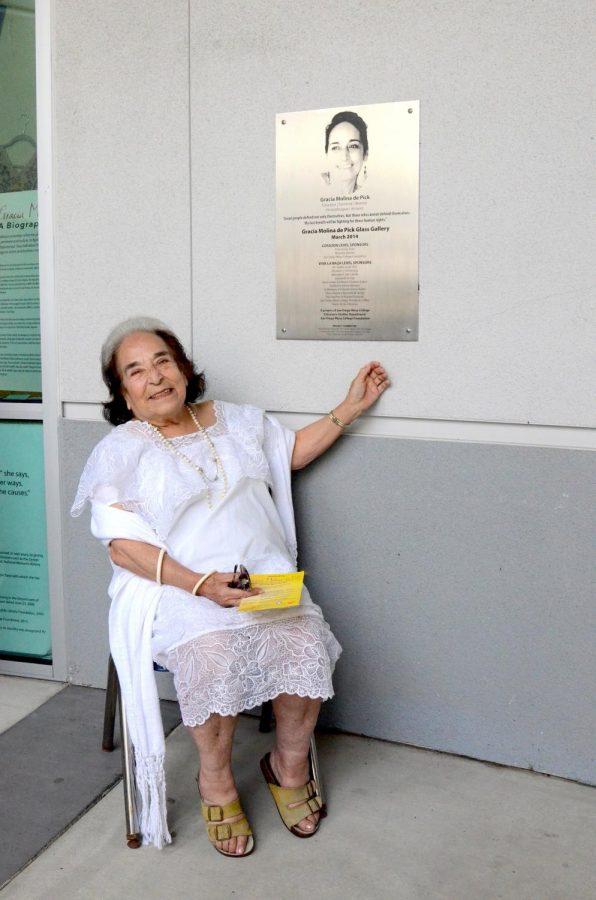
Figure 1. Gracia Molina de Pick with her plaque at her namesake Glass Gallery at San Diego Mesa College, established to recognize her contributions to the Chicano/a program at the college.
At the University of California San Diego, Molina de Pick was also a founding member of Thurgood Marshall College (Third College), and helped establish Chicano(a) studies as integral to the standard curriculum.
Her advocacy for access to education extended beyond the classroom, as she was also a fierce advocate for increasing the number of libraries in Mexican American communities. She saw these third spaces as an opportunity for families, educators, and students alike to come together and learn. de Pick advocated for and financially supported the establishment of educational programs in Spanish in local libraries (Sainz).
PRIMARY SOURCE: KPBS INTERVIEW WITH MOLINA DE PICK
Gracia Molina de Pick sits down with KPBS for their Celebrating Cultural Diversity series honoring local heroes for Hispanic Heritage Month. Molina de Pick shares her long-standing admiration for libraries and describes how they can provide access to education while also serving as a community hub for collective learning.
In addition to developing programs at universities and libraries in her community, de Pick was also a founding member of the Association of Mexican American Educators (AMAE) in 1965 and the San Diego chapter president. The AMAE was organized “to address the problems facing Chicano(a) students in the schools, with their efforts being “directed toward the elimination of English only rules, toward scholarships to encourage students to continue their education, and toward a drive to attract more Latinos to educational careers and into positions of leadership of influence” (AMAE). Today, the mission of the AMAE has broadened to ensure quality educations for Mexican American and Latino students through access to financial resources and community partnerships. Molina de Pick’s involvement in creating this organization further demonstrates her commitment to education access for those in her community.
Molina de Pick was appointed to the California Postsecondary Education (CPEC) in 1957 as the first San Diegan, effectively moving beyond San Diego-exclusive education advocacy. The CPEC, now defunct, “provided analysis and advice on a range of higher education issues for more than 30 years” (Public Policy Institute of California). California Governor Jerry Brown ultimately deemed the CPEC ineffective in 2011 and did not approve renewed funding.
At Mesa College, UC San Diego, and CPEC, de Pick sought to emphasize the importance of Chicano(a) contributions to local and national culture and history. Through these achievements, de Pick used her knowledge and positions to advocate for and enact social and structural changes to better reflect the contributions of minoritized communities, which would extend beyond education and into Molina de Pick’s political engagement.
Beyond Education: Molina de Pick’s Political Activism
de Pick’s political activism, as previously mentioned, began in her youth and continued throughout her life. As mentioned, she immediately got involved within the Chicano(a) Movement when she moved the United States in 1957. In the 1960s, de Pick helped found IMPACT,” an early community grassroots organization fighting for the civil rights of Mexican Americans in San Diego” (KPBS). In 1970, de Pick helped found the first national Chicana association, Comision Femenil Mexicana Nacional, at the Mexican American National Issues Conference in Sacramento, California. The organization was founded “within the milieu of the Chicano movement as a space for Chicana self-determination and self-sufficiency that subverted cultural nationalist ideals about gender and set itself apart from the movement’s rhetoric...Women formed the CFMN in order to leverage power for themselves within movements they characterized as exclusionary” (Chavez, 60).
In addition to her helping found the CFMN, de Pick was also a fierce advocate for immigrants' rights. As a Mexican immigrant to United States herself, de Pick understood what it meant to be “a border woman” (VFA). She specifically notes how experience with violence as a border woman has inspired her to pursue activism and social change: “I know what violence is like. I’m a feminist because very early on I felt the anger of being told what I could or could not be...However, I did perceive because of my family having been involved in the Mexican Revolution, that there were ways in which you could change the way things were. And one was the revolution on guns and the other was through the vote” (VFA).
de Pick’s advocacy for immigration rights and equality extended beyond immigrants themselves. de Pick understood that to advocate for immigrants’ rights was also to advocate for women’s right, again highlighting the role that violence plays as “...violence [against the immigrant community] but it’s violence against each one of you too, because as women we all suffer that violence of [having things] imposed things upon us and of being identified as not being white” (VFA). Through her commitment to immigrants’ rights, de Pick’s advocacy also demonstrates how the need for collective action against oppression is the only way to achieve collective liberation from these systems.
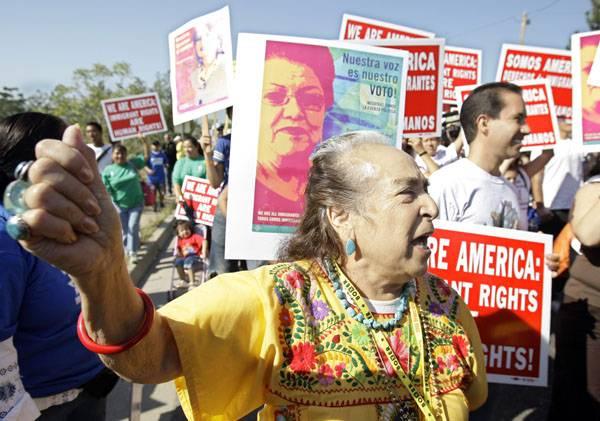
Figure 2. Gracia Molina de Pick protesting at an immigration march during the 2008 Democratic National Convention in Denver (AP Photo/Matt Rourke)
In addition to the CFMN and her role in immigration advocacy, de Pick was also involved in the National Women’s Political Caucus (NWPC), Mexican American Women’s National Association (MANA), National Council of La Raza, United Farm Workers, and Chicano Federation. She also served on the Census Advisory Committee for the Spanish Origin Population for the 1980 census. During the 1970s, she was critical in the work of international women’s conferences, such as the United Nations International Women’s Year Conferences in Mexico City, Mexico (1975); Nairobi, Kenya (1985); and Beijing, China (1995). She also participated in the United States Bicentennial National Women’s Conference in Houston, Texas (1976). Through these conferences, de Pick had a “profound impact on women around the world” (Sevilla Productions).
de Pick’s engagement with political activism coincided with her ventures in education advocacy: de Pick navigated a world in which Mexican Americans were underrepresented and underserved, yet was able to affect tangible change in policies, systems, and structures through her activism to better include the Mexican American experience. For Chicanas in particular, de Pick continuously fought for inclusion beyond race, effectively making her one of the most memorable Chicana feminists of the 20th and 21st centuries.
Continued Impact: Activist Roots Blossomed Throughout Her Life
de Pick continued in her advocacy throughout the rest of her life. She served as the Human Resource Consultant for the Agency for International Development of the U.S. State Department in the African Bureau and for the Women’s Bureau of the U.S. Department of Labor prior to her retirement. She also published the book Mujeres en la Historia/Historias de Mujeres in collaboration with Carmen Lugo in 2008, which “highlights women in Mexican history, covering the indigenous period prior to 1492 through the half of the 20th Century,” and a marker of her continued commitment to sharing and emphasizes the importance of Chicana histories in our culture, country, and society (KPBS).
Finally, de Pick’s commitment to education access continued through her life, with her donation to the Logan Heights Library’s foundation in San Diego in 2009 helping this public resource and community space open its doors. de Pick’s achievements and contributions to the Chicano(a), women, and labor movements have been recognized on local, state, and national levels. Mesa College in San Diego continues to celebrate Molina de Pick’s contributions to their Chicano studies program through the annual Gracia Molina de Pick Feminist Lecture Series (San Diego Mesa College). As articulated by the college, this series “has successfully attracted a wide range of campus and community members from the regional to San Diego Mesa College to reflect on the importance of Chicana/o Studies, Women’s Rights, Civil Rights, Community Service and Education” (San Diego Mesa College).
de Pick passed away in 2019 following a life committed to activism, social justice, and equality. She is remembered for her fierce commitment to advocating for the rights and inclusion of the Hispanic community, particularly in the field of education, as well as her advocacy for women’s, labor, and immigrant rights. In the video “Remembering a San Diego Icon,” one member of the community shares that “[Molina de Pick] was adamant about not only expressing her point of view, but in terms of defending the rights of all people.” (Sevilla Productions, 3:01)
 Works Cited

AMAE. “History of AMAE.” Association of Mexican American Educators Oxnard Chapter, n.d. https://amaeoxnard.wordpress.com/history-of-amae/.
Chávez, Marisela R. “Forging a Chicana Feminist Praxis.” Chicana Liberation, University of Illinois Press, 2024. https://doi.org/10.5622/illinois/9780252045707.003.0003.
Facing History & Ourselves. “Background on the Chicano Movement.” Last updated April 16, 2020. https://www.facinghistory.org/resource-library/background-chicano-movement#citation-information-543.
Gracia Molina De Pick, photograph source unknown, https://veteranfeministsofamerica.org/vfa-pioneer-histories-project-gracia-molina-de-pick/.
International Union of Socialist Youth. “History.” International Union of Socialist Youth, n.d. https://iusy.org/this-is-us/history#:~:text=On%20August%2024%20%E2%80%93%2027%2C%201907,Improving%20opportunities%20for%20youth%20education.
KPBS Public Media. “Gracia Molina Enriquez de Pick.” KPBS, 2010. https://www.kpbs.org/news/kpbs/2010/09/23/gracia-molina-enriquez-de-pick.
“Remembering a San Diego Icon.” Sevilla Productions, 2021. https://www.youtube.com/watch?v=ombnvqXZHCg&t=4s.
Rourke, Matt. Photograph of Gracia Molina de Pick during an immigration march. AP Photo, 2008. https://www.summitdaily.com/news/immigration-advocates-march-in-denver-for-rights/.
Sainz, Pablo Jaime. “Gracia Molina de Pick: A strong voice in San Diego education.” La Prensa, 2014. Last updated Sep 13. 2023. https://laprensa.org/gracia-molina-de-pick-strong-voice-san-diego-education.
San Diego Mexican & Chicano History. “Chapter 11.5 San Diego Chicano History.” San Diego Mexican and Chicano History, n.d. https://chicanohistory.sdsu.edu/chapter11/c11s05.html.
San Diego State University. “Gracia Molina de Pick Papers.” Special Collections & University Finding Aid Database, n.d. https://archives.sdsu.edu/repositories/2/resources/285.
Veteran Feminists of America. “Interview with Gracia Molina de Pick.” Veteran Feminists of America, inc., 2006. https://veteranfeministsofamerica.org/vfa-pioneer-histories-project-gracia-molina-de-pick/interview-gracia-molina-de-pick/.
Veteran Feminists of America. “VFA PIONEER HISTORIES PROJECT: GRACIA MOLINA DE PICK.” Veteran Feminists of America, inc., n.d. https://veteranfeministsofamerica.org/vfa-pioneer-histories-project-gracia-molina-de-pick/.
Warren, Paul. “Coordinating California’s Higher Education System.” Public Policy Institute of California, 2019. https://www.ppic.org/publication/coordinating-californias-higher-education-system/.
Wilkins, John. “Educator, social activist Gracia Molina de Pick dies at 91.” The San Diego Union-Tribune, 2019. https://www.sandiegouniontribune.com/2019/08/20/educator-social-activist-gracia-molina-de-pick-dies-at-91/.
Primary Source Analysis Strategies
PRIMARY SOURCE 1: Photograph of Gracia Molina de Pick with her plaque at her namesake Glass Gallery at San Diego Mesa College. [Link]
Question 1: What is the legacy of naming a building?
Question 2: What do you wonder about the process of dedicating buildings to individuals?
PRIMARY SOURCE 2: KPBS INTERVIEW WITH MOLINA DE PICK
Question 1: How might access to a community library help bring people together?
Question 2: What role has libraries played in your own life?
PRIMARY SOURCE 3: Gracia Molina de Pick yells during an immigration march at the Democratic National Convention in Denver, Thursday, Aug. 28, 2008. [Link]
Question 1: What do you see in the image?
Question 2: What emotion does the image evoke?
Additional Resources
“Gracia Molina de Pick, San Diego Women’s Hall of Fame, 2002.” Center for Women’s History, 2010. https://www.youtube.com/watch?v=C8kmTPv9zrM.
San Diego State University. “Gracia Molina de Pick Papers.” Special Collections & University Finding Aid Database, n.d. https://archives.sdsu.edu/repositories/2/resources/285.
Lesson Plan
Related Biographies
Carry the Torch
Veteran Feminists of America, n.d. https://veteranfeministsofamerica.org
Maria Guadalupe Evangelina de Lopez
Chávez, Marisela R. “Forging a Chicana Feminist Praxis.” Chicana Liberation, University of Illinois Press, 2024. https://doi.org/10.5622/illinois/9780252045707.003.0003.
How to Cite this Page
MLA – Vandy, Scottie. “Gracia Molina de Pick.” National Women’s History Museum, 2025. Date accessed.
Chicago – Vandy, Scottie. “Gracia Molina de Pick.” National Women’s History Museum. 2025. https://www.womenshistory.org/education-resources/biographies/Gracia-Molina-de-Pick