Wendy Red Star
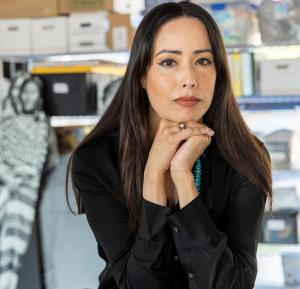
Wendy Red Star is an Apsáalooke (Crow) artist who through her work explores themes of Native history, resistance, and cultural heritage.
Her breakthrough work, Four Seasons, set the tone for her later career as an artist that deals with heavy topics relating to Native subjects, such as racial stereotypes and violence, with humor and frankness.
Her continued output focuses on the artistic heritage of Native women, drawing attention to the silences in art historical canon that have discounted their work.
“One thing I hope that people get from my work is that they actually have more questions when they leave. It leaves an impression on them so much so that it sparks their curiosity to continue learning.”
Wendy Red Star Interview with MacArthur Fellowship, 2024
Early Life and Education
Wendy Red Star was born in 1981 in Billings, Montana at the Apsáalooke (Crow) Indian Reservation (pronounced “up-SAW-low-guh”) (Myers, 2022). Montana has a large indigenous presence with an indigenous population of 78,000 people, making up over 6% of the state population. The area around Red Star’s hometown includes the Tsetsêhesêstâhase (Northern Cheyenne) Reservation (pronounced “tse-TSES-tas”) and the historic lands of the Sioux (pronounced “soo”), Assiniboine (pronounced “uh-SIN-uh-boyn”), and Niitsitapi (Blackfeet) tribes (pronounced “nee-it-see-TAH-peh”). She grew up surrounded by what she described as a distinctive “Crow aesthetic.” The women in her family constantly created works of art for regular use, such as beaded dresses, which has inspired her focus on elevating Native women’s work in her own art, as she described for Harper’s Bazaar:
“My grandmother and aunts were constantly beading; my grandma was making all of her grandchildren traditional outfits, but none of the community ever thinks about our culture or designs as art—they’re just representative of the entire community’s aesthetic. It’s what makes us Crow.”
Interview with the MacArthur Fellowship, 2024
She received a Bachelor of Fine Arts from Montana State University in 2004 and a Master of Fine Arts in Sculpture from University of California, Los Angeles in 2006. She had trouble fitting in while attending art school, describing her struggle with balancing the pursual of artistic success and honoring her heritage in her work:
“In grad school, it used to be pretty torturous because the message I felt I was receiving was that if I wanted to have success within my art career, I would have to change a lot of my aesthetic values and make great compromises. I’m big on integrity and authenticity, and I thought that would actually kill me if I had to go with what didn’t feel right, especially in creative endeavors.”
Interview with Juxtapoz, 2025
Four Seasons (2006)
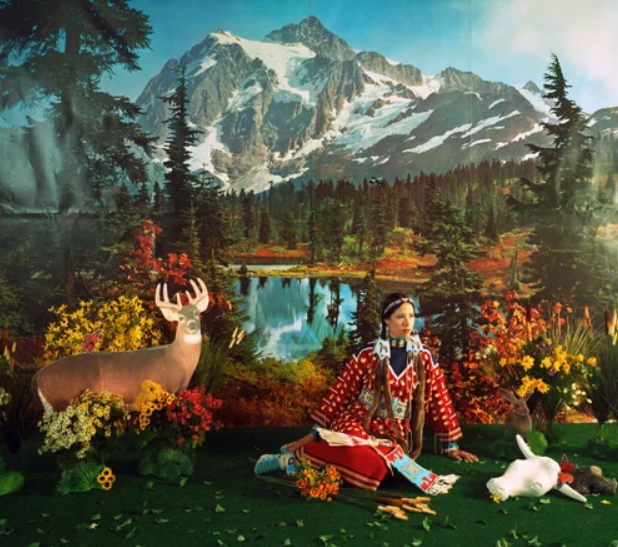
Figure 1. Wendy Red Star, Summer, 2006
While a student at UCLA, she created her breakthrough series, which caught the attention of the art world and launched her career, entitled Four Seasons. Lonely and missing home, she went to the Natural History Museum in Los Angeles to see Native Crow objects. She was struck by the framing of her community’s heritage, which invited visitors to first see the dinosaurs and take in a world that was extinct before they visited Native works, leading them to consider Native communities extinct in the same way. Inspired by the dioramas in the museum she created scenes of painted sets, plastic animals, and herself sitting around the intricately fictive nature. Yet, the dress that she wears is tangibly authentic; the elk teeth dress is an object of great cultural and personal significance, typically made by women. Red Star wears it in her work to embody the matrilineal society in which she was raised, and to represent the women in her family who, though she sits alone, are alongside her in that garment.
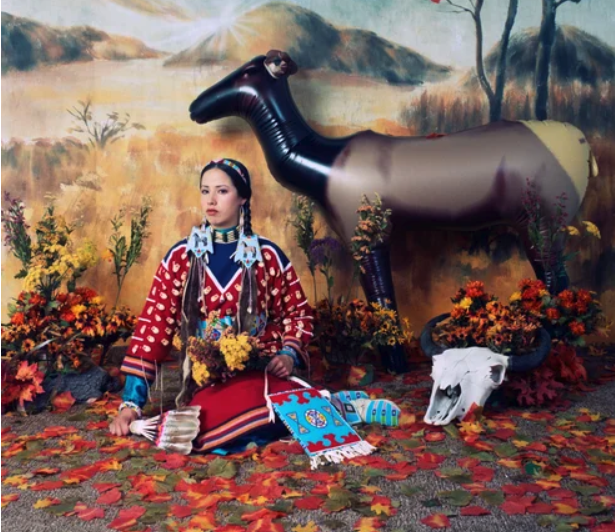
Figure 2. Wendy Red Star, Fall, 2006
1880 Crow Peace Delegation (2014)

Figure 3. Wendy Red Star, Peelatchiwaaxpáash / Medicine Crow (Raven), 2014.
Realizing that a historic portrait of Crow Chief, Medicine Crow, was being used on a bottle of tea, Red Star wondered if the people who used the image knew who he was. She was quickly drawn into research, curious about the context of the historic photograph, taken as part of the Crow Indian Delegations which traveled to Washington D.C. in 1873 and 1880. Her research notes became a part of the artwork, superimposed on the portraits from the National Anthropological Archives in red ink. The notes include personal thoughts, historical research, and context on Crow culture. She employs language as a tool to reframe perspectives in the history of colonialism, using humor and knowledge production to situate Native voices in their own histories.
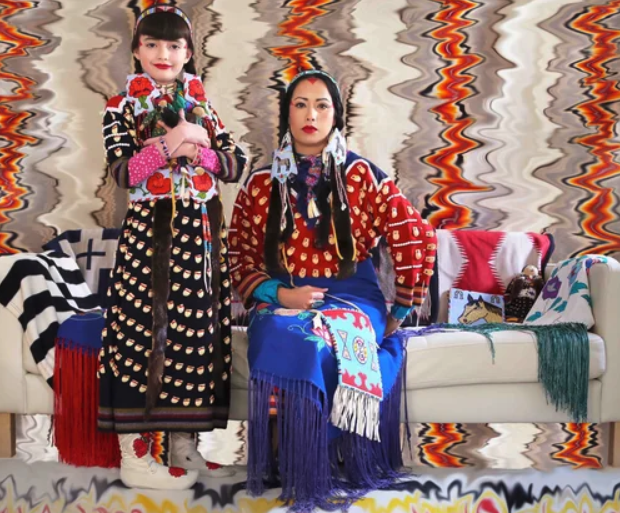
Figure 4. Wendy Red Star, Apsáalooke Feminist #1, 2016.
Throughout her career, Red Star celebrates Native women and brings visibility to their art. In this work, she focuses on the matrilineal structure of Crow society by photographing herself and her daughter, Beatrice, wearing traditional elk tooth dresses which she made by hand. She created this work as a response to historical depictions by outsiders to the indigenous community which primarily center men.
“You even see it in museums that have collections of Native art and Native galleries. The stories are about chiefs and warriors. You’re not thinking about the women who actually made the majority of those objects, like the war shirt worn by the chief. The women are these silent forces that get no recognition or credit, even though they have basically created the legacy of the aesthetic for the community.” - Wendy Red Star interview with Harper’s Bazaar
Indian Congress, 2021
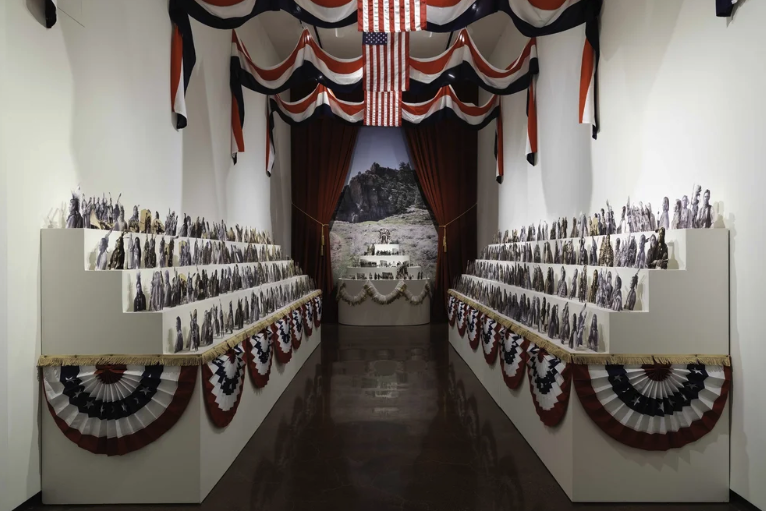
Figure 5. Wendy Red Star, Indian Congress, 2021.
Red Star constructed Indian Congress for the Joslyn Art Museum in Omaha, Nebraska. Red Star situates the art around a large lightbox landscape of Mount Tahoma, inspired by Japanese woodblock landscapes. Populating the congressional seats are portraits of Native women and children, which she intends to deconstruct class divides inherent in portraiture and reframe historical perfectives on Native women’s roles. Red Star hopes that this work will inspire other Native people to see themselves represented both in contemporary art and in their own histories.
“I think about myself as a little kid coming into a museum and seeing a work like that, I would feel acknowledged. I think Native people need heroes.” - Wendy Red Star interview with Seattle Art Museum, 2022
The Soil You See (2023)
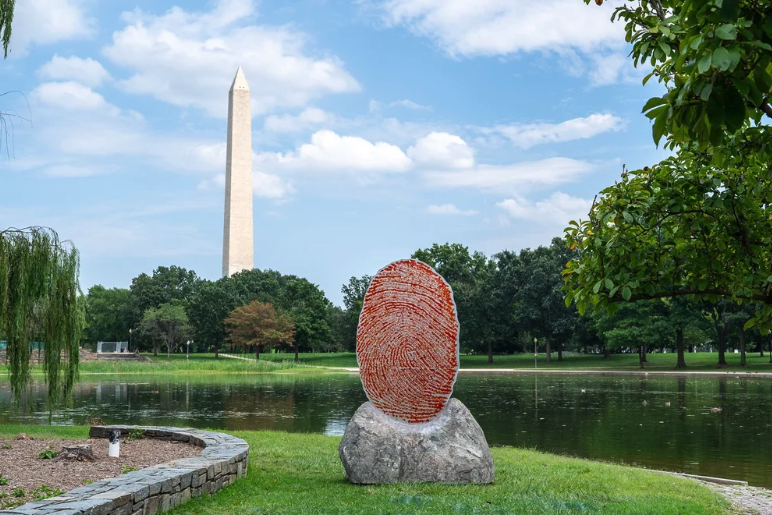
Figure 6. Wendy Red Star, The Soil You See..., 2023.
Inscribed with the names of 51 Crow chiefs who the United States government coerced into signing treaties between 1825-1880, this site-specific monument is in dialogue with the nearby 56 Signers of the Declaration of Independence Memorial. With their thumbprints, these Crow chiefs made official transfers of tribal land to the U.S. government. With its location on the National Mall, The Soil You See highlights the realities of diplomatic relations with the federal government that Native tribes faced through treaties and the ambassadorial visits Native dignitaries completed in D.C. The Soil You See marks a return to sculpture as a medium for Red Star, who uses this medium to explore the story of land appropriation and displacement.
Red Star’s heritage and family remain at the core of all she does. On a visit home, she received the name Baahinnaachísh or Baaeétitchish (One Who Is Talented) from her family, in reference to her grand-uncle, Clive Francis Dust, Sr., renowned in his community as a creative and preserver of cultural heritage.
 Primary Source Analysis

Museums and Indigenous Heritage (Grades 3-6)
Wendy Red Star, Four Seasons (2006)
1. Have you been to a museum before? If yes, What kind of museum? What kind of objects were there, and how were the objects displayed? If no, what do you imagine is in a museum?
2. Look at Wendy Red Star’s Four Seasons series. What do you see? What looks real, and what looks fake? Does it remind you of a museum display?
3. Why would Red Star show herself in a kind of museum display? What is she trying to say about how Native American life is displayed in museums? Why?
Photographs and Historical Memory (Grades 9-12)
Wendy Red Star, 1880 Crow Peace Delegation (2014)
1. How do we remember historical events? Brainstorm a list of all the ways we preserve history. What are the pros and cons of each method?
2. Look at Wendy Red Star’s 1880 Crow Peace Delegation series. What do you notice about how she’s altered these photographs? What statement is she making about historical records?
3. Look closely at the notes in one photograph of the series. What do you learn through her notes? Does it make you view the photograph differently?
Public Space and Cultural Heritage (Grades 5-9)
Wendy Red Star, The Soil You See... (2023)
-
What do you know about the Declaration of Independence? How many people signed it? Who can you name?
-
What do you know about Apsáalooke (Crow) treaties with the U.S. government? How many of the tribe leaders who signed those treaties can you name?
-
Look at Wendy Red Star’s The Soil You See. What do you notice about it? Where is it? How does it make you feel?
-
Why would Red Star compare the Declaration of Independence to Apsáalooke (Crow) treaties?
Marsh, Ariana. “Wendy Red Star Is Decolonizing the Art World With Humor—and Help From Her Ancestors.” Harper’s Bazaar. October 4, 2024. https://www.harpersbazaar.com/culture/features/a62503702/wendy-red-star-is-decolonizing-the-art-world-with-humorand-help-from-her-ancestors
Mass MoCA. “Wendy Red Star. Apsáalooke: Children of the Large-Beaked Bird.” Massachusetts Museum of Contemporary Art. Accessed October 7, 2025. https://massmoca.org/event/wendy-red-star
Myers, V. (2022, November 10). Keeping tradition and language alive. AFT Voices. https://www.aftvoices.org/keeping-tradition-and-language-alive-408670b4dfc3
Red Star, Wendy. “1880 Crow Peace Delegation.” Wendyredstar.com. Accessed October 9, 2025. https://www.wendyredstar.com/1880-crow-peace-delegation
Red Star, Wendy. “An Indigenous Gaze Towards the Future: Wendy Red Star Recontextualizes Native Culture in Outer Space.” Interview with Tara Anne Dalbow for Artillery Magazine. November 14, 2024. https://www.robertsprojectsla.com/news/an-indigenous-gaze-towards-the-future-wendy-red-star-recontextualizes-native-culture-in-outer-space
Red Star, Wendy. “Artist Talk: Wendy Red Star on “Four Seasons” and Reclaiming Indigenous Narratives.” Interview with Shana Lopes for the San Francisco Museum of Modern Art. June 24, 2022. https://www.youtube.com/watch?v=19L4P1INPro
Red Star, Wendy. “Opening New Doors for Native Women: Wendy Red Star on Making American Art Welcoming to All.” Interview with the Seattle Art Museum. September 1, 2022. https://www.youtube.com/watch?v=YzpuEu9veRk
Red Star, Wendy. “Wendy Red Star: 2024 MacArthur Fellow.” Interview with Macfound. October 1, 2024. https://www.youtube.com/watch?v=WmZDAgHBuGU
Red Star, Wendy. “Wendy Red Star: A Scratch on the Earth.” Interview with State of the Ars New Jersey. March 25, 2019. https://www.youtube.com/watch?v=vyJiXXXH2WE
Red Star, Wendy. “Wendy Red Star on ‘Four Seasons,’ 2006.” Interview with The Tang Teaching Museum. October 8, 2024. https://www.youtube.com/watch?v=xG6CilH4A6I
Red Star, Wendy. “Wendy Red Star reflects on representation and the joy of working with students.” Interview with Massachusetts Museum of Contemporary Art. February 9, 2022. https://www.youtube.com/watch?v=uobSdd17Fts
Red Star, Wendy. “Wendy Red Star: What’s In a Name.” Interview with Shaquille Heath for Juxtapoz Art & Culture. Accessed October 7, 2025. https://www.juxtapoz.com/news/magazine/features/wendy-red-star-what-s-in-a-name
“Tribal Territories in Montana.” Montana State University. January 14, 2019. https://www.montana.edu/iefa/introductiontomttribalnations/tribalterritories.html
MLA — McKelvie, Lydia. “Wendy Red Star.” National Women’s History Museum, 2025. Date accessed.
Chicago — McKelvie, Lydia. “Wendy Red Star.” National Women’s History Museum. 2025.https://www.womenshistory.org/education-resources/biographies/Wendy-Red-Star.
Zitkála-Šá ("Red Bird"/Gertrude Simmons Bonnin)

Amanda Blackhorse
Kimberly Teehee