Phillis Wheatley
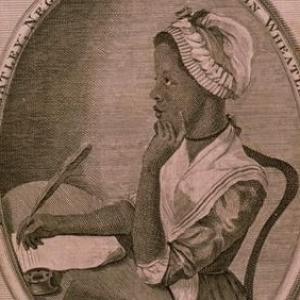
Phillis Wheatley Peters is broadly recognized as the first African American and the second U.S. woman to publish a book of poetry.
She started publishing poetry as a teenager and became well known among English-speakers for her elegies of religious figures and her discourses on liberty and freedom.
She was an ardent supporter of the American Revolution, notably writing a poem dedicated to George Washington in 1775, and protesting tyrannical colonial rulers, referencing her own enslavement.
“Should you, my lord, while you peruse my song,
Wonder from whence my love of Freedom sprung,
Whence flow these wishes for the common good,
By feeling hearts alone best understood…”
Wheatley, to the Right and Honorable William, Earl of Dartmouth, 1772
Early Life
Phillis Wheatley was born around 1753 in the nations of Senegal and the Gambia in Western Africa. Her early life, before being kidnapped and trafficked to North America in 1761, remains unknown. Upon arrival in Boston, she was sold to the Wheatley family. Phillis became the domestic servant and companion of Mrs. Susannah Wheatley (Mount Vernon).
As part of assimilationist and racist practices, Wheatley was renamed. The first name “Phillis”, was derived from the ship that brought her to North America, “the Phillis.” While the last name was assigned to her because of the family who bought her. John Wheatley was a prominent merchant with extensive real estate and shipping businesses. Her birth name remains unknown today, as it was erased through the process of enslavement, an act that reflects the broader dehumanization of Black and Brown people.
At the time of her first enslavement, Phillis did not speak English. In the Wheatley household, she was tutored by their daughter Mary and received the education of a young woman of the white elite. Yet she was legally and socially separated from other women of her education due to being enslaved (Boston Public Library). Within sixteen months of beginning her lessons, she could read the Bible, Greek and Latin classics, and British literature. She also studied astronomy and geography. Wheatley’s education was extremely rare for enslaved people in the 18th century; at the time of the Revolutionary War, less that 5% of enslaved persons were literate. However, some in puritan-adjacent circles, such as the Wheatley family, felt that it was their Christian moral duty to educate those enslaved so that they could read religious texts (Encyclopedia Virginia).
In her early teenage years, Wheatley began to write poetry, publishing her first poem, “On Messrs. Hussey and Coffin,” in 1767 in the Newport Mercury, a weekly newspaper in Rhode Island. The poem describes a story told by one of the Wheatley family’s dinner guests of a narrow escape of being shipwrecked. The forward of the poem, likely written by John Wheatley, says that she heard the story while “tending the table” and was inspired to write the verse, inviting the readers to marvel at her abilities despite her enslaved status. The same newspaper would also host advertisements for slave markets and rewards for the capture of enslaved people that had self-emancipated (Massachusetts Historical Society, Newport History). Her 1770 poem “An Elegiac Poem, on the Death of the Celebrated Divine George Whitefield,” dedicated to a famous English preacher, made her a household name (Mount Vernon; Boston Public Library).
Poetry Career & Emancipation
Many of Wheatley’s poems addressed her enslavement and connected her desire for freedom with revolutionary ideals. For example, her 1772 poem “To the Right Honourable William, Earl of Dartmouth,” dedicated to the new secretary of state for the American colonies, expressed her hope that he would wield his power justly. She described the trauma of being kidnapped in her youth which compelled her to write about freedom and compared England to an enslaving force that held the colonies captive (Gilder Lehrman Institute).
“Should you, my lord, while you peruse my song,
Wonder from whence my love of Freedom sprung,
Whence flow these wishes for the common good,
By feeling hearts alone best understood,
I, young in life, by seeming cruel fate
Was snatch’d from Afric’s fancy’d happy seat:
What pangs excruciating must molest,
What sorrows labour in my parent’s breast?
Steel’d was that soul and by no misery mov’d
That from a father seiz’d his babe belov’d:
Such, such my case. And can I then but pray
Others may never feel tyrannic sway?”
Wheatley, to the Right and Honorable William, Earl of Dartmouth, 1772
In March 1773, with financial support from the English Countess of Huntingdon, who was an admirer of her work, Wheatley traveled to London with the Wheatley's son to publish her first collection of poems, Poems on Various Subjects, Religious and Moral—the first book written by an enslaved African American woman in America (Mount Vernon). The collection included a forward, signed by John Hancock and other Boston notables—as well as a portrait of Wheatley—all designed to prove that the work was indeed written by a Black woman (Massachusetts Historical Society). The portrait was likely drawn by enslaved artist Scipio Moorhead in Boston, who knew Wheatley personally, and to whom she dedicated the poem “To S. M. a Young African Painter, on seeing his works.” Moorhead depicted Wheatley deep in thought and engaged in writing, identifying her as an intellectual at work. It is the first book frontispiece which depicts a woman writer in America, and possibly the first portrait of an American woman while writing (Black Art Magazine).
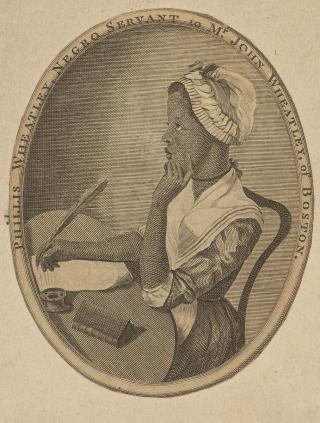
Figure 1. Attributed to Scipio Moorhead, Phillis Wheatley, 1773. Metropolitan Museum of Art, New York.
Wheatley’s time in England exposed her to new ideas about freedom and her relationship to it. The year prior, in June of 1772, the English Court ruled in the case Somerset v. Stewart that enslavement was not supported by any valid English statute, meaning that any enslaved person in England should be considered legally free. Her book was popular with abolitionists in England and France, who used it to argue that Wheatley was a genius unjustly enslaved (Mount Vernon).
When she returned early to North America in September due to Susanna Wheatley’s ill health, she likely negotiated for her freedom, leveraging her fame, pressure from her English admirers, and the legal possibility of suing for her freedom from England (James G. Baker, Gilder Lehrman Institute, Massachusetts Historical Society Boston Public Library).
“To His Excellency George Washington”
In June 1775, as George Washington was appointed to Commander in Chief of the Continental Army by the Second Continental Congress, Wheatley felt inspired to write to him and dedicate a poem in his honor (James G. Baker, Gilder Lehrman Institute). She sent “To His Excellency General Washington,” with a letter on October 26, 1775. This poem became one of her most famous works:
“I Have taken the freedom to address your Excellency in the enclosed poem, and entreat your acceptance, though I am not insensible of its inaccuracies. Your being appointed by the Grand Continental Congress to be Generalissimo of the armies of North America, together with the fame of your virtues, excite sensations not easy to suppress.”
Phillis Wheatley to George Washington, 26 October, 1775
In the poem, she refers to North America as Columbia, derived from the name of 15th century figure Christopher Columbus. Wheatley personifies Columbia as a woman who guides the American people to their future and blesses Washington and his war efforts. This also reflected Wheatley’s puritan influences through her reference to destiny and providence (Mount Vernon). There is no evidence that Wheatley ever met Washington before writing to him. However, she likely knew of him as a military commander and understood the significance of this appointment to the burgeoning American Revolution.
“Celestial choir! Enthroned in realms of light,
Columbia’s scenes of glorious toils I write.
While freedom’s cause her anxious breast alarms,
She flashes dreadful in refulgent arms.
See mother earth offspring's fate bemoan,
And nations gaze at scenes before unknown!
See the bright beams of heaven’s revolving light
Involved in sorrows and the veil of night!
The goddess comes, she moves divinely fair,
Olive and laurel binds her golden hair:
Where shines this native of the skies,
Unnumbere’d charms and recent graces rise.”
Poem by Phillis Wheatley, 26, October 1775
Washington did not read the poem until February 1776, as it had been mixed up with papers to discard. Upon finding it, he was greatly encouraged by her writing and wanted it to be published (Mount Vernon). Washington, a notorious plantation owner who sought to recapture self-emancipated people, wrote to Wheatley to praise her work and invite her to meet him in at Continental Army headquarters, although she likely never accepted the invitation (Mount Vernon). His words read as ironic to modern audiences, knowing that he profited from and continued to rely on slavery for the course of his life.
“If you should ever come to Cambridge, or near Head Quarters, I shall be happy to see a person so favoured by the Muses, and to whom nature has been so liberal and beneficent in her dispensations. I am, with great Respect, Your obedient humble servant, G. Washington.”
George Washington to Phillis Wheatley, 28 February 1776
In March 1776, the poem was published in the Virginia Gazette, emphasizing Wheatley’s race in the headnote: “The following letter and verses were written by the famous Phillis Wheatley, the African Poetess, and presented to His Excellency Gen. Washington.” The poem was also published in April 1776 in the Pennsylvania Magazine. It was well-received from the public, serving to further Washington’s public image and contributing to Wheatley’s growing fame as a poet (James G. Baker, Gilder Lehrman Institute).
Later Life and Legacy
In the years of the American Revolution and the years that followed, Wheatley kept working to write and publish poetry. Soon after her first book of poetry of poems was published, she started work on a second collection. This volume, which would have included thirteen letters and thirty-three poems, was never finished. The manuscript remains lost, although recent efforts by scholars and archivists have partially re-created the work (Michelle Levy). In 1778, Wheatley married John Peters, a free Black man from Boston with whom she birthed three children, though none survived. To support her family, she worked as a maid in a boardinghouse while continuing to write poetry. Wheatley became ill and died on December 5th, 1784 (Mount Vernon, Massachusetts Historical Society).
Wheatley’s work continues to be studied, especially for the tensions she presented through her writing and her life surrounding freedom in the emerging United States. Her childhood enslavers, whose name she bore her entire life, raised her to write poetry and engage with their literary traditions. She used that very tool, her written word, to call for freedom and question the institution of slavery, and the fame she gained by doing so led to her own emancipation. Yet, she would continue to support a revolution in which she and others like her had no hope of true liberty, praising a planter like Washington who would continue to both support and rely on the institution of slavery. While she was not the only African American, enslaved or free, who supported the Patriot cause, her writings about the American Revolution continue to illustrate these contradictions and reveal lesser-known perspectives on the founding of the United States.
 Primary Source Analysis Strategies

Phillis Wheatley, “To the Right and Honorable William, Earl of Dartmouth,” 1772. Published in Poems on Various Subjects, Religious and Moral, 1773. Massachusetts Historical Society.
-
This poem by Wheatley addresses William Legge, the new secretary of state for the American colonies in 1772. On your first read, what are three words, images, or phrases that stand out to you? What do these words/images/phrases reveal to you about the values which are important to Wheatley?
-
How does Wheatley reference her personal experience in this poem?
-
What is Wheatley’s goal for this poem? Use three pieces of evidence in the text to support your claim.
Phillis Wheatley to George Washington, and Enclosure: Poem by Phillis Wheatley, 26, October 1775. From Founders Online.
-
Read this letter and enclosed poem which Wheatley addressed to George Washington when he was appointed Commander in Chief of the Continental Army. How would you characterize the figure of “Columbia” using evidence from the text?
-
What is Wheatley’s central thesis in this poem? Use three phrases or images from the text to support your claim.
-
Is there anything in or about the text that surprises you?
“African Americans and the End of Slavery in Massachusetts.” Massachusetts Historical Society. Accessed June 8, 2026. https://www.masshist.org/features/endofslavery/wheatley.
Armenti, Peter. “Phillis Wheatley.” Library of Congress, March 1, 2012. Accessed February 10, 2015. https://blogs.loc.gov/catbird/2012/03/phillis-wheatley/.
Basker, James G. “A Poem Links Unlikely Allies in 1775: Phillis Wheatley and George Washington.” History Now, Issue 39 (Spring 2014). Accessed Online June 8, 2026, The Gilder Lehrman Institute of American History. https://www.gilderlehrman.org/history-resources/essays/poem-links-unlikely-allies-1775-phillis-wheatley-and-george-washington.
Berkin, Carol. Revolutionary Mothers: Women in the Struggle for America’s Independence. New York: Alfred A. Knopf, 2005.
Bly, Antonio T. “Literacy and Education of the Enslaved in Virginia.” Encyclopedia Virginia. Accessed June 15, 2026. https://encyclopediavirginia.org/entries/slave-literacy-and-education-in-virginia/.
Holmes, Don. “Phillis Wheatley.” Mount Vernon. Accessed June 8, 2026. https://www.mountvernon.org/library/digitalhistory/digital-encyclopedia/article/phillis-wheatley#3.
“How They Made Black Art History: Scipio Moorhead.” Black Art Magazine. Accessed June 15, 2026. https://blackartmagazine.com/insights/black-art-history/scipio-moorhead/.
Levy, Michelle. “A Volume of Manuscript Poems &c”: Phillis Wheatley Peters's Lost Book and a Found Proposal. Eighteenth-Century Life 1 January 2024; 48 (1): 183–216.
Moschella, Jay. “Tracing the Life of Phillis Wheatley Peters.” Boston Public Library. September 21, 2023. https://www.bpl.org/blogs/post/tracing-the-life-of-phillis-wheatley-peters/.
“Phillis Wheatley’s poem on tyranny and slavery, 1772.” The Gilder Lehrman Institute of American History, accessed June 8, 2026. https://www.gilderlehrman.org/history-resources/spotlight-primary-source/phillis-wheatleys-poem-tyranny-and-slavery-1772.
“Phillis Wheatley.” Notable Black American Women. Gale, 1992. U.S. History in Context. Web. Accessed February 10, 2015.
Sewall-Belmont House, Black Women in America, Peake Delancey, 2003.
Weatherford, Doris. American Women’s History: An A to Z of People, Organizations, Issues, and Events. New York: Macmillan General Reference, 1994.
Yeager, Amelia. “History Bytes: Phillis Wheatley’s Newport Mercury Connection.” Newport Historical Society. July 3, 2023. https://newporthistory.org/history-bytes-phillis-wheatleys-newport-mercury-connection/.
Zuck, Rochelle Raineri. “Poetic economies: Phillis Wheatley and the production of the black artist in the early Atlantic world.” Ethnic Studies Review 33.2 (2010): 143+. U.S. History in Context. Accessed February 10, 2015.
Image credit
Library of Congress
MLA — “Phillis Wheatley.” National Women's History Museum. National Women's History Museum, 2015. Revised 2026. Date accessed.
Chicago — “Phillis Wheatley.” National Women's History Museum. 2015. Revised 2026. www.womenshistory.org/education-resources/biographies/phillis-wheatley.
Mercy Otis Warren