
Women’s Suffrage Cartoons
Grade Level
5th
Subject Area
Social Studies or Media Studies
Related Documents
Download Full Lesson Plan +
This lesson can be integrated into units on voting and voting rights, media literacy, or Women’s History Month. Using political cartoons from the suffrage movement, students will investigate how both pro- and anti-suffrage groups used media to shape public opinion and communicate their messages during a pivotal moment in United States history.
Big Ideas
Mass Media is used to influence public opinion related to social issues. How did the political cartoons from the turn of the 19th century and the first two decades of the 20th century attempt to influence and persuade the opinions of both the anti- and pro- movements, as well as undecided citizens?
Two, 45-Minute Classes
- Students will investigate ways in which both the suffragists and anti-suffragists used media (political cartoons) to get their messages across.
- Students will identify, explain, and interpret three ways/techniques the illustrator used to create the message.
Essential Vocabulary
Suffrage
Persuasion
Mass media
Media literacy
Political cartoons
Anti-Suffrage
Pro-Suffrage
Symbolism in Art
Early 20th-Century Traditional Gender Roles
Primary Sources
Political Cartoons
- LOC: “For the benefit of the girl about to graduate / Charles Howard Johnson.”
- LOC: “[The sky is now her limit] / Bushnell 20.”
- LOC: “Looking backward/Laura E. Foster.”
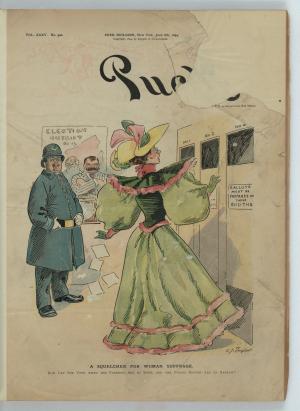
- LOC: “A squelcher for woman suffrage / C.J. Taylor.”
- LOC: “A female suffrage fancy / J. Keppler.”
- LOC: “Shall women vote? Ehrhart.”
Images
- LOC: “At the emancipated women's club”
- LOC: “Election Day!”
- LOC: “Flocking for freedom”
- LOC: (20 items from 1910–1919)
- NWHM: Primary Sources Sets
Other Sources
NWHM: Crusade for the Vote
Biographical Articles
NWHM: Suffragist Biographies
Physical Materials
Summarizer
Graphic Organizer
Warm-Up
Instructor will share an image of political cartoons from the Library of Congress representing a historical are in American history (WWI, for instance).
The instructor will ask questions:
- What do you see?
- What do you notice?
- What do you wonder?
- What do you recognize?
Direct Instruction
The instructor will explain that historical cartoons played a role in shaping public opinion about various events in American history, and that the cartoonists employed various techniques to get across their messages.
The instructor will ask students to notice details and techniques the illustrators used to direct the viewer’s point of view.
Questions to Ask Students:
- What might exaggerated facial features mean?
- What might it mean if a person in power is depicted as threatening?
- What symbols are used in the cartoon?
- How does a viewer react to a person in a cartoon who is beautiful, well-dressed, calm
The instructor will ask students to identify other aspects in the illustration that seems to be directing the viewer towards a certain point of view.
The instructor will explain that the issue of women’s suffrage was also a common theme for cartoonists for many years. Instructor will share images of two suffrage political cartoons—one anti-suffrage, one pro-suffrage—from 1880–1919, from the Library of Congress. (See list of sources provided above).
The instructor will model how to interpret aspects of the image by providing students with a list of techniques and stereotypes that an illustrator might use to convey messages:
- Angry, misshapen, and violent women and weak, unhappy men are depicted in anti-suffrage cartoons.
- Elegant, well-dressed, serene, calm women are depicted in pro-suffrage cartoons
- Patriotic symbols such as the American flag, the Statue of Liberty, and the scales of justice might be included
- Depictions of motherhood are common in both pro- and anti- suffrage messages
- Facial expressions, text within the cartoon, colors used, exaggerated features, clothing, symbols, captions, patriotic symbols, and aspects of homelife are aspects to be considered and interpreted
- An anti-suffrage cartoon might depict an angry, distorted, violent woman who ignores her family to join a suffrage march. A man in an anti-suffrage cartoon looks sad and confused, as neglected children cry around him. Men might be shown wearing an apron or holding a frying pan in a role typically deemed ‘women’s work.’
The instructor will lead a discussion about how perceived gender roles of the early part of the 20th century played a significant role in supporting or opposing suffrage; i.e., if women vote, men will be forced to take on traditional female roles, such as childcare and cooking, making men weak and broken. Women would neglect their primary roles as mothers and wives.
Students Will Consider the Questions:
- Is the cartoon effective?
- What messages are being sent?
- Do the various techniques help persuade the viewer?
Guided Practice
The instructor will share an additional cartoon, giving students time to look over the image, then will ask students to share observations about the possible meanings of the cartoon.
- Is it pro-suffrage? Anti ?
- What did they notice that led them to their conclusion?
- Students will turn and talk with a classmate and discuss what they notice.
- Students will explain their interpretation to their classmates and provide reasons for their interpretation.
- Students will be invited to contribute ideas to whole group discussion.
Independent Practice
Students will select two images of a suffrage political cartoon or image (one pro, one anti) from the Library of Congress website.
- The student will identify at least three techniques contained in the cartoon that are meant to convey a message or persuade the viewer.
- Students will analyze the cartoon to determine if the message is pro or anti-suffrage.
- Students will articulate how they came to their conclusion, citing evidence from the cartoon.
- Students will create a poster using a printed copy of the cartoon, and circle and annotate the three persuasive techniques they have identified within the political cartoon.
- Students will fill in a graphic organizer in which they write their interpretation of the message the cartoonist intended to convey to the viewer.
Closure / Exit Ticket
At end of class, students will be asked to respond briefly (2–3 minutes) to one of the following questions:
- What is one thing that surprised or challenged you in today’s lesson?
- What questions do you still have about today’s lesson?
- Can you apply to what you learned about political cartoons from 100 years ago to a cartoon from today?
Formative Assessment
Students will complete a poster with annotations of the techniques employed by cartoons in 2 different cartoons. (See graphic organizer for this poster).
Summative Assessment
- Provide students with a suffrage cartoon image they have not yet seen; ask them to identity if the cartoon is pro or anti suffrage.
- Students circle and annotate two details within the cartoon that support their answer; how do these two items explain your position.
- Explain the term: Suffrage.
Modification & Accommodation
- Students can work in pairs;
- Students can verbally explain their interpretation of the cartoons rather than write answers;
- Students can select one rather than two cartoons to annotate.
Extension & Enrichment Activities
- Interested students can visit the National Women's History Museum website and explore Crusade for the Vote to learn more about the history of the 19th Amendment
- Students can visit suffragists biographies on the National Women’s History Museum to learn more about the trailblazers who worked to secure the right to vote
C3 Framework Standards Addressed
D2.His.11.3—5. Infer the intended audience and purpose of a historical source from information within the source itself.
