
Alma Thomas: An Artist Out of this World
Grade Level
3rd • 5th
Subject Area
Social Studies or Media Studies
Related Documents
Download Full Lesson Plan +
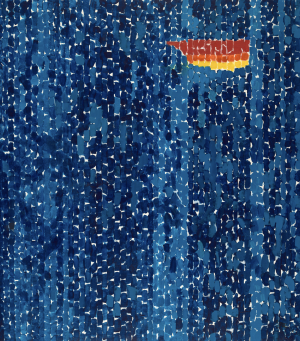
Alma Thomas was the first black female artist to have a solo exhibition at the Whitney Museum of American Art in 1972. Her work was deeply inspired by the curiosity, energy, and unknown possibility of early space exploration of the 1950s–1970s. Students will investigate how the intense space race between the United States and the Soviet Union heavily influenced Alma Thomas’s artwork and conveyed the popular attitudes and political energy of the times. Students will create their own abstract art with color, rhythm, and balance as well as consider how current Americans might feel should we return to the moon with Elon Musk’s Space X Artemis launch.
Big Idea
How does the work of Alma Thomas capture the energy and importance of the Space Race between the United States of America and the Soviet Union?
2 Hours
- Students will be able to define the “Space Race.”
- Students will be able to analyze the elements of art and principles of design in Alma Thomas’s Space series.
- Students will be able to explain the popular sentiments and feelings of Americans toward space exploration from 1957–1975.
- Students will create their own abstract representations of space in the style of Alma Thomas.
Essential Vocabulary
The Space Race
The Space Race grew out of the Cold War between the United States and the Soviet Union, the most powerful countries after World War II. For a half-century, the two superpowers competed for supremacy in a global struggle across a variety of areas from military might to consumer goods. Space was a crucial and new arena for the Cold War rivalry. Before a watchful world, each side sought to demonstrate its superiority through impressive feats in rocketry and spaceflight. In addition to these milestones, technologies used for spaceflight had further applications. Rockets could launch missiles, while satellites could keep an eye on adversaries. National Air and Space Museum. “The Space Race.” Smithsonian National Air and Space Museum, 2023, airandspace.si.edu/explore/stories/space-race.
Soviet Union
U.S.S.R. or USSR or officially Union of Soviet Socialist Republics former country 1922–91 in eastern Europe and northern Asia bordering on the Arctic and Pacific oceans and Baltic and Black seas; capital Moscow area 8,649,512 square miles (22,402,236 square kilometers)
Note: The Soviet Union, a union of constituent republics (Armenia, Azerbaijan, Belorussia, Estonia, Georgia, Kazakhstan, Kyrgyzstan, Latvia, Lithuania, Moldavia, Russia, Tajikistan, Turkmenistan, Ukraine, and Uzbekistan), existed from 1922 to 1991 and during that time was the largest country in the world in terms of land area. SOVIET UNION Definition & Meaning: Merriam-Webster
Cold War
The ideological conflict between the U.S. and the Soviet Union during the second half of the 20th century COLD WAR Definition & Meaning:Merriam-Webster
Sources
- Alma Thomas: Your New Favorite Artist. National Gallery of Art (video).
- The Race Begins. Chapter 2, from the book, Race to Space by Patricia Hutchinson. EPIC! (book chapter).
- The Space Race for Kids | Apollo 11 | History Made Easy. Bedtime History (video/podcast).
- New Moon. Reds Launch First Space Satellite, 1957/10/07: Internet Archive. Library of Congress (video).
- The Moon Landing Was the Television Event of the Decade. Smithsonian Channel (video).
- What Being A Witness To The 1969 Moon Landing Was Like. Grunge (video).
- Return to Space | Official Trailer | Netflix. Netflix (video).
- Ablaze with Color: A Story of Painter Alma Thomas. Art with Mrs. F (video).
Materials
- Samples of Alama Thomas’s work from her space series including, “Starry Night with the Astronauts,” “Orion,” “The Eclipse,” “Snoopy- Early Sun Display on Earth,””Blast Off,” and “Apollo 12 Splashdown.”
- Sentence strips with titles of Alma’s work
- Acrylic paint, canvas, and brushes
- Modern photographs of outer space
- Video clips (provided)
Warm-Up
Display the artwork titles written on large sentence strips: “Starry Night with the Astronauts,” “Orion,” “The Eclipse,” “Snoopy- Early Sun Display on Earth,””Blast Off” and “Apollo 12 Splashdown.” Ask students what do all these titles have in common?
Explain that space exploration became an inspiration and focal point for America and the Soviet Union from 1957 to 1975. One artist in particular, Alma Thomas, would gain surprising recognition for her space series paintings inspired by these events.
Watch National Gallery of Art “Alma Thomas: Your New Favorite Artist” for background information on the artist.
Now reveal the images of art that correspond with the titles already displayed.
Ask Students
- Which titles do they think belong to which pieces and why?
- What feelings do these pieces of art create for you?
Direct Instruction
Understanding the Historical Background: Why did Alma paint about space?
Project or print out copies of Chapter 2 “The Race Begins” from the book, Race to Space by Patricia Hutchinson this is available on platforms such as EPIC. Have students take turns reading the chapter out loud.
Another Option
Listen to The Space Race for Kids | Apollo 11 | History Made Easy (starting at 1:10–6:45).
Turn and Talk to a Friend:
“In your own words explain what the space race was.” “What were the feelings around advancing technologies on both sides?” “Why was this important?”
Watch: New Moon. Reds Launch First Space Satellite, 1957/10/07 : Internet Archive.
- How does the music and video create a distinct mood?
- How might Americans have felt watching this?
Explain that the Space Race essentially ended with the United States launching Apollo 11 and landing on the moon on July 16th 1969.
Watch the Following Clips
Watch from minutes 5:23–7:23.
The Moon Landing Was the Television Event of the Decade
What Being A Witness To The 1969 Moon Landing Was Like
- As a class do a round robin exercise and ask students for one word only to describe what this event must have been like to witness for example: “surprising, unbelievable, proud, breathtaking.”
- Do you think everyone felt the same way about the moon landing?
- Why do you think Alma chose to paint about space at this time?
Guided Practice
Understanding Alma’s Style
- Return to the paintings of Alma Thomas to analyze them further.
- What do you notice about the way Alma painted? How did she use color?
- Alma is known for her use of balance. Which paintings feel heavy? Symmetrical or asymmetrical? Which ones have radial balance?
- How did Alma create a focal point? How did she depict rhythm or movement?
Independent Practice
Student Created Artwork
- Allow students to pick from modern day photographs of space as their inspiration for their own abstract painting in the style of Alma Thomas.
- Students should use small continuous brush strokes with negative space in between. Flat brushes with a square head work best. Students should compose these strokes in continuous vertical columns or horizontal rows with saturated bright colors.
Summarizer
A Return to Space
Watch: Netflix Trailer Return to Space (just the trailer)
Exit ticket
Do you think Americans are still inspired by space? Could another space race occur? Explain.
Modification & Accommodation
- An alternative biography for Alma Thomas is Ablaze with Color: A Story of Painter Alma Thomas by Jeanne Walker Harvey, or listen to the book read aloud on YouTube.
- For student artwork, If paint and canvas is not available, students can use small strips of torn construction paper, glued to white paper instead.
- Students may decide to take their own photographs of the sky to inspire their abstract paintings.
Extension & Enrichment Activities
- Conduct your own space race- divide the class into 2 teams to build lego rockets and the first team to finish wins.
- Examine some of the political cartoons depicting the space race. Analyze their meaning and create your own.
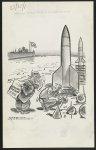
Block, Herbert, Artist. “Can you hurry? We’re in an important race”. [1–29] Photograph.
Retrieved from the Library of Congress
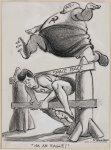
Mauldin, Bill, Artist. “I’m an eagle”. [Aug. 8 publication date] Photograph.
Retrieved from the Library of Congress
C3 Framework Standards Addressed
D2.His.5.3—5. Explain connections among historical contexts and people’s perspectives at the time.
D2.His.4.3—5. Explain why individuals and groups during the same historical period differed in their perspectives.
D2.His.6.3—5. Describe how people’s perspectives shaped the historical sources they created.
