Mercy Otis Warren
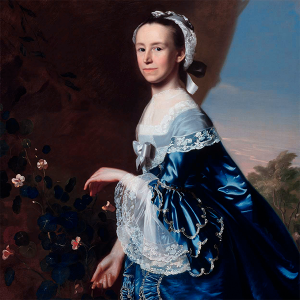
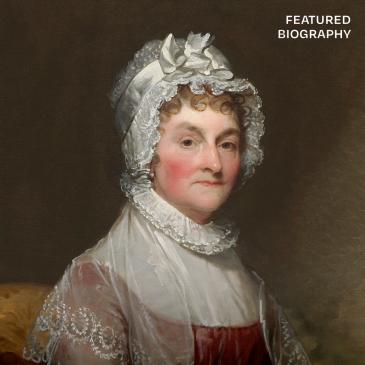
Mercy Otis Warren was a published poet, political playwright and satirist during the age of the American Revolution—a time when women were encouraged and expected to keep silent on political matters.
Warren had close relationships and correspondence with the leading figures of the day, such as John and Abigial Adams.
She became an outspoken commentator and historian, as well as the leading female intellectual of the Revolution and early republic.
“But why should not the same Heroic Virtue, the same Fortitude, patience and Resolution, that Crowns the memory of the ancient Matron, Adorn the Character of Each modern Fair who Adopts the signature of Portia. Surely Rome had not severer tryals than America, nor was Cesar in the senate with his Flatterers, and his Legions about him, more to be Dreaded than George the 3d with his parasites in parliment, and his murdering Mercenaries in the Field.”
Mercy Otis Warren to Abigail Adams, 1777
On the Margins of the Revolution
Born on September 14, 1728, in Barnstable, Massachusetts, Warren was the third of thirteen children and the oldest daughter of James Otis and Mary Allyne Otis. Her exposure to politics began early; her father was an attorney who was elected to the Massachusetts legislature in 1745. Like most girls at the time, Warren had no formal education; hers came from sitting in on her brother’s lessons while they prepared for college, where she took a particular interest in history and politics. With her brothers, she studied Greek and Roman literature, ancient and modern history, and English literature, such as the works of Shakespeare, Pope, and Milton. Her family supported her learning, especially her brother James Otis, a notable patriot and lawyer, who uplifted her work throughout his life. She also made extensive use of her uncle’s large book collection to educate herself. In 1754, she wed the politically active James Warren, a classmate of her brother at Harvard. The couple had five sons.
After James’ selection to the Massachusetts Legislature in 1766, the Warrens’ home became a center of political discourse, particularly for those opposed to British policies. At the outset of the American Revolution, James served in the Continental Army as Paymaster General. Due to her social connections and the high-ranking role her husband held in the Continental Army, Mercy Warren had an unrivaled access to the political, military, and philosophical actors of the American Revolution. This enabled her to grow her career as a writer through their promotion of her work during the Revolution and in the early Republic and adapt her work perfectly to the tastes of patriot audiences.
At this time, Warren began a lifelong friendship with Abigail Adams. Warren and Adams corresponded frequently, offering mutual aid during the war and exchanging books as part of a female literary network. In a letter from 1 March 1777, she displayed the full range of the mutual support they offered the other as she comforts Adams during the separation from her husband. Warren encouraged her to think of their mutual ideals about the future of America.
“I do not wonder at the Regrets you Express at the distance and absence of your Excellent Husband.
But why should not the same Heroic Virtue, the same Fortitude, patience and Resolution, that Crowns the memory of the ancient Matron, Adorn the Character of Each modern Fair who Adopts the signature of Portia. Surely Rome had not severer tryals than America, nor was Cesar in the senate with his Flatterers, and his Legions about him, more to be Dreaded than George the 3d with his parasites in parliment, and his murdering Mercenaries in the Field.
But as I have several other Letters to write this day, I must speedily descend from the Altitudes of Heroism, and talk in the simple stile of the Manufacturer and the Humbler Language of the Domestic Dame: who seeketh Wool and Flax and Worketh Willingly with her hands.”
Letter to Abigail Adams, 1 March 1777
Poems, Plays, and Propaganda
An avid patriot, Warren began writing political dramas that denounced British policies and key officials in Massachusetts, notably Governor Thomas Hutchinson. Her work, especially poems and plays such as The Squabble of the Sea Nymphs and Ladies of Castille frequently centered women, especially in their roles to influence their male family members to patriotic action. She was a strong proponent of Republican Motherhood: the idea that women should be active politically as mothers in order that their children can be good citizens of the new republic.
Her 1772 satire, The Adulator (published anonymously in the Massachusetts Spy newspaper), criticized the British colonial governor’s policies a full four years before Jefferson wrote the Declaration of Independence. The play includes the characters Rapatio, the corrupt, villainous governor, based on Royal Governor of Massachusetts Thomas Hutchinson, and the revolutionaries Brutus, based on her brother James, Rusticus, based on her husband, and Hortensius, based on John Adams. Warren published several additional plays skewering British colonial leaders, including Defeat (1773), The Group (1775), Blockheads (1776), and The Motley Assembly (1779). All of these works were published anonymously, likely to avoid retaliation for the patriot ideals she expressed within them, but also to have her work taken seriously as a female author.
Following the end of the Revolutionary War, Warren began to cut ties with former friend John Adams over the issue of the governmental structure in the U.S. Constitution, which Warren and her husband believed was too centralized. In 1788, she penned “Observations on the New Constitution” and published it with the penname “a Columbian Patriot,” denouncing the constitution and alienating Federalist friends. Through this work, she continued to demonstrate her beliefs that women should freely express ideas about politics and even governmental structures; a system in which she and other women would not be able to participate in as voters and office holders for over a century.
In 1790, Warren published Poems, Dramatic and Miscellaneous, the first work she had ever published under her own name, making her the third American woman, after Ann Bradstreet, and Phillis Wheatley, to publish a book of poetry in her name. Her publications shaped the patriot cause during the war and continue to effect revolutionary memory today. She received sparkling reviews from major figures in the budding American Republic, such as Thomas Jefferson and Alexander Hamilton, many of whom credit her with being a theretofore unheard-of female genius.
“Madam, in making you, thus late, my acknowledgements for the honor you did me by presenting me with a volume of your poems, I dare not attempt an apology for the delay. I can only throw myself upon your clemency for a pardon. I have not however been equally delinquent towards the work itself, which I have read more than once with great interest...Not being a poet myself, I am in the less danger of feeling mortification at the idea that in the career of dramatic composition, at least, female genius has outstripped the male.”
Alexander Hamilton to Mercy Otis Warren, July 1, 1791
The book consists of her 2 plays and 18 poems; many previously published in newspapers. The new works in the book were largely elegies dedicated to the loved ones she lost over the previous decades, including her brother, James, who became Disabled after a blow to the head in 1769 and died in 1783, her sister Mary, who died in 1763, and her son, Charles, who died in his twenties from tuberculosis in 1785.
Her poems were about freedom, liberty, and virtue for the burgeoning country and for women. In one poem, “The Squabble of the Sea Nymphs,” a satirical allegory of the Boston Tea Party, she slipped in commentary regarding women in politics, as she wrote:
“For females have their influence over kings, nor wives nor mistresses were useless things. Even to the gods of ancient Homer’s page, then sure in this polite and polished age, none will neglect the sex’s sage advice when they engage in any point so nice as to forbid the choice nectars sip and offer buoy to the rosy lip.”
In this line, she implied that wives and mothers influence men in their private lives and therefore enact large effects on public affairs. It is a subtle closing of the space between public and private life, in which she questions these boundaries and argues for women’s essential roles in the new republic.
A Woman Writing History
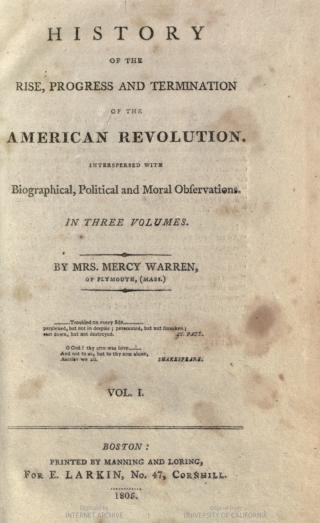
Figure 1. History of the Rise, Progress and Termination of the American Revolution. Biographical, Political and Moral Observations by Mrs. Mercy Warren of Plymouth, (Mass.).
From the outset of the American Revolution, Warren began writing its history, which was published in 1805 as History of the Rise, Progress and Termination of the American Revolution. This was among the first nonfiction book published by a woman in America. She was not alone in her work as a female historian in the 18th century and was likely inspired by the celebrated English writer Catharine Sawbridge Macaulay, whose work History of England, From the Accession of James I to That of the Brunswick Line published in 1783 was widely acclaimed. Warren was also inspired by the events of her own life and the sense that she had lived through an undeniably important historical event that deserved documentation. This was an effort she began even before the Declaration of Independence was written and signed. Warren was hopeful from the first days of the American Revolution that it would lead to egalitarian and democratic policies in the new republic and beyond.
As much as Warren was uplifted by major figures in the early Republic, History of the Rise, Progress and Termination of the American Revolution. had made her a share of enemies as well. John Adams became a major opponent of the work, leading the two into an embittered public battle over the contents of the work. As a Jeffersonian Republican, she took a firm stand against ratification of the Constitution, putting her at odds with her former friend, Adams, a champion of the document. Adams published essays refuting her anti-federalist ideals and lambasting her in private correspondence. As he wrote to General Elbridge Gerry in April 1813:
“History is not the Province of the Ladies. These three Volumes nevertheless contain many Facts, worthy of Preservation. Little Passions and Prejudices, want of Information, false Information, want of Experience, erroneous Judgment, and frequent Partiality, are among the Faults.”
John Adams to Elbridge Gerry, April 17, 1813.
“The veracity of an historian is his strongest base; and I am sure I have recorded nothing but what I thought I had the highest reason to believe. If I have been mistaken I shall be forgiven; and, if there are errors, they will be candidly viewed by liberal-minded and generous readers.”
Mercy Warren defended both her work and her role as a historian, in a letter dating 28 July 1807.
Already aged seventy-seven at the time of publishing the History of the Rise, Progress, and Termination of the American Revolution, she did not continue to publish work afterwards. She remained active, however, even in her final years, continuing to write and correspond with political friends. Warren lived to age eighty-six, and she is buried in Plymouth, Massachusetts.
Her work remains important as a primary source to understand the political and philosophical driving forces of the American Revolutionary War. In addition, she provided a key perspective on women’s roles within political discourse of that time period. She wrote and published overtly political material in a time period in which women had little access to the public sphere of politics. She centered women in her narratives and encouraged them to be political actors, within in their families and through their pens, for the betterment of their new nation.
 Primary Source Analysis Strategies

Letter: Mercy Otis Warren to Abigail Adams, 1 March 1777. Massachusetts Historical Society. https://founders.archives.gov/documents/Adams/04-02-02-0122
-
Read this letter from Mercy Otis Warren to Abigail Adams, dated 1 March 1777. After your first read, list the top 5 words/phrases/images that stand out to you from the letter.
-
What are some of the hardships that Warren describes herself facing or Adams facing?
-
What kind of support does Warren offer Adams during the Revolutionary War? Is it emotional, financial, philosophical, political, logistical? Use three examples from the text to support your claim.
Mercy Otis Warren’s Political Views
Letter: “To John Adams from Mercy Otis Warren, 10 March 1776,” Founders Online, National Archives, accessed May 27, 2026, https://founders.archives.gov/documents/Adams/06-04-02-0019.
-
Read this letter from Mercy Otis Warren to John Adams, from 10, March, 1776. In small groups, make a word map of words/phrases that stand out to you and use lines to connect similar ideas and concepts.
-
Having made this word map, how would you summarize Warren’s thesis about the future of American governance? Use three examples from the text to support your claim.
Book: Mercy Otis Warren, History of the Rise, Progress, and Termination of the American Revolution. 1805. Princeton University Library Digital Collection. https://catalog.princeton.edu/catalog/9925288843506421
-
Read the introduction or “An Address” section of Warren’s History of the Rise, Progress, and Termination of the American Revolution. What are Warren’s reasons for writing this history?
-
What challenges or pitfalls did she face in writing this work?
Erhard, Katharina. “Rape, Republicanism, and Representation: Founding the Nation in Early American Women’s Drama and Selected Visual Representations.” Amerikastudien / American Studies 50, no. 3 (2005): 507–34. http://www.jstor.org/stable/41158171.
Feer, Robert. “Mercy Otis Warren” in James, Edward T., Janet Wilson James, Paul S. Boyer. Notable American Women: 1607-1950, A Biographical Dictionary. Cambridge: Belknap Press, 1971.
King, Martha J. “The ‘Pen of the Historian’: Mercy Otis Warren’s History of the American Revolution.” The Princeton University Library Chronicle 72, no. 2 (2011): 513–32.
Lauter, Paul, ed. “Mercy Otis Warren (1728-1814)” in The Heath Anthology of American Literature, Fifth Edition. Accessed February 10, 2015.
"Mercy Otis Warren." Encyclopedia of World Biography. Detroit: Gale, 1998. U.S. History in Context. Accessed February 10, 2015.
“Mercy Otis Warren Papers: Biographical Sketch.” Massachusetts Historical Society. Accessed February 10, 2015.
Mercy Otis Warren to Abigail Adams, 1 March 1777. Massachusetts Historical Society. https://founders.archives.gov/documents/Adams/04-02-02-0122.
Sarkela, Sandra J. “Freedom’s Call: The Persuasive Power of Mercy Otis Warren’s Dramatic Sketches, 1772-1775.” Early American Literature 44, no. 3 (2009): 541–68. http://www.jstor.org/stable/27750149.
“To John Adams from Mercy Otis Warren, 10 March 1776,” Founders Online, National Archives, accessed May 27, 2026, https://founders.archives.gov/documents/Adams/06-04-02-0019.
Weatherford, Doris. American Women’s History: An A to Z of People, Organizations, Issues, and Events. New York: Macmillan General Reference, 1994.
MLA — “Mercy Otis Warren.” National Women's History Museum. National Women's History Museum, 2015. Revised 2026. Date accessed.
Chicago — “Mercy Otis Warren.” National Women's History Museum. 2015. Revised 2026. www.womenshistory.org/education-resources/biographies/mercy-otis-warren.
Books
Dubois, Ellen Carol and Lynn Dumenil. Through Women’s Eyes: An American History with Documents. (Boston: Bedford/St. Martins, 2009). Pp. 153-154.
Kerber, Linda K. Women of the Republic: Intellect and Ideology in Revolutionary America. Chapel Hill, 1980.
Norton, Mary Beth. Liberty's Daughters: The Revolutionary Experience of American Woman, 1750-1800. Boston, 1980.
Web Sites
Baym, Nina. “Mercy Otis Warren’s Gendered Melodrama of Revolution.”
Abigail Smith Adams