
Augusta Savage: Shaping a Future for Black Artists
Grade Level
Grade 5
Subject Area
Elementary History & Social Studies
Related Documents
Download Full Lesson Plan +
James Weldon Johnson’s poem set to music is often referred to as the “Black National Anthem.” It has inspired many artists including Augusta Savage whose similarly titled sculpture, “Lift Every Voice and Sing” also known as “The Harp,” was commissioned for the 1939’s world fair. Augusta Savage’s life and work would reflect not only the economic hardship of the Great Depression but also the growing movement towards civil rights.
She would become a significant influence for other African American Artists to excel during the Harlem Renaissance. Sadly the legacy of work has been largely lost or destroyed further augmenting the inequality and obstacles many black Americans have faced. Students will dive deeply into the meaning of Augusta Savage’s work and her influences.
Big Ideas
How does Augusta Savage’s commissioned work for the 1939 World’s Fair reflect the economic hardship of the Great Depression and symbolize the beginnings of the Civil Rights Movement?
90 Minutes
- Students will be able to sequence significant events in the life and work of Augusta Savage.
- Students will be able to critique Augusta Savage’s sculpture “Lift Every Voice and Sing” also known as “The Harp” using the Edmund Feldman’s art criticism model: Describe, Analyze, Interpret, and Decide.
- Students will be able to identify elements in Augusta’s work that are influenced by the work of James Weldon Johnson’s poem and music of John Rosamond Johnson.
- Students will be able to identify the significance of Augusta’s life and work as it relates to the larger context of the Harlem Renaissance, Great Depression, and rise of the Civil Rights Movement.
Essential Vocabulary
Commissioned
Ordered to be made in exchange for payment. Merriam-Webster
The Great Depression
Worldwide economic downturn that began in 1929 and lasted until about 1939. It was the longest and most severe depression ever experienced by the industrialized Western world, sparking fundamental changes in economic institutions, macroeconomic policy, and economic theory. Encyclopedia Britannica
Harlem Renaissance
A blossoming (c. 1918–1937) of African American culture, particularly in the creative arts, and the most influential movement in African American literary history. Encyclopedia Britannica
Civil Rights Movement
Mass protest movement against racial segregation and discrimination in the southern United States that came to national prominence during the mid-1950s.
Sculpture
A three-dimensional work of art (such as a statue). Merriam-Webster
Bronze
An alloy of copper and tin and sometimes other elements. Merriam-Webster
Materials & Resources
- Primary Source Analysis Tool
- Teacher’s Guide: Analyzing Sound Recordings
- Paper/pencil
- Audio of “Lift Every Voice and Sing”
- Timeline photographs and dates of Augusta Savage’s life and historical events
- Copies of both the lyrics to “Lift Every Voice and Sing” and photographs of the sculpture, “The Harp”
- Doc Chat Episode 36: Augusta Savage’s “Lift Every Voice and Sing,” A Treasure of Liberation from The New York Public Library on Vimeo
Warm–Up
Distribute photographs depicting important events in Augusta’s life and corresponding note cards with information about her life and concurrent world events. Have students find their partner by matching dates and arrange students sequentially to present their information to the class. Once all students have presented, ask the group to sort their events into the categories of Life/ Culture/ and Money. Ask the following guided questions:
- Where and when did Augusta experience obstacles in her life and work?
- Which category—life, culture, or money—affected her the most?
- How did she help other black artists? Why is she an important female artist to learn about?
Augusta Savage: Life and Work Timeline
Display the timeline somewhere in your classroom so that students can reference the life and work of Augusta Savage throughout the lesson.
1892 Born on February 29 in Green Cove Springs, Florida.
1907–1919 Moves to West Palm Beach; begins formal training and teaching art. Marries and later becomes widowed; continues pursuing art while raising her daughter.
1921–1923 Moves to New York City during the early years of the Harlem Renaissance. Accepted to Cooper Union for the Advancement of Science and Art; tuition is waived due to her talent.
1925 Selected for a summer art program in France, but funding is withdrawn after objections to a Black woman attending. Savage speaks out publicly against the decision, drawing national attention to racial discrimination in arts funding, stating that the rejection was not about merit but race.
1929 Wins a Julius Rosenwald Fund fellowship, allowing her to study in Paris.
1930–1931 Studies sculpture in France; exhibits internationally and gains critical recognition.
1930 The Great Depression begins.
1931 Savage struggles financially as private patronage collapses during the Depression; she often lacks money for materials and studio space. She returns to the United States.
1934–1935 Becomes the first Black member of the National Association of Women Painters and Sculptors. Helps organize and exhibit in the Salon of Contemporary Negro Art in New York City. The Salon provides a rare professional exhibition space for Black artists who were routinely excluded from white-run galleries and museums.
1935 Founds the Savage Studio of Arts and Crafts in Harlem, providing affordable art education to young Black artists during the Depression.
1936 Appointed director of the Harlem Community Art Center, funded by the Works Progress Administration (WPA). Mentors artists such as Jacob Lawrence, Norman Lewis, and Gwendolyn Knight.
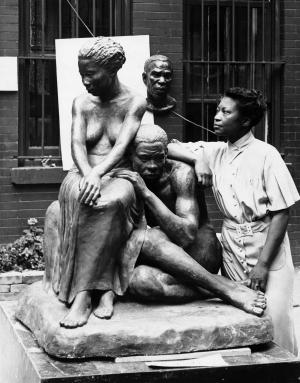
1937–1939 Creates her most famous work, Lift Every Voice and Sing (also known as “The Harp”), for the 1939 New York World’s Fair. She is the only Black female sculptor commissioned. Despite its popularity, she is not paid enough to cast the sculpture in bronze; the original plaster work is destroyed after the fair due to lack of funds for preservation.
1940s–1950s (Context) The Civil Rights Movement begins. Many of Savage’s works are lost or destroyed because she cannot afford proper storage or casting.
1954–1962 Lives quietly in New York while the modern Civil Rights Movement gains momentum nationwide. She dies on March 27 in New York City.
Guided Practice
Take a closer look at Augusta Savage’s art.
“Lift Every Voice and Sing,” also known as “The Harp,” was commissioned for the 1939 World’s Fair in New York and it took over a year for Augusta to complete. Display or project a copy of Augusta’s sculpture for the whole class to see. Explain that the sculpture “Lift Every Voice and Sing” was heavily inspired by James Weldon Johnson’s poem of the same name with music from James Weldon Johnson. It is largely considered the Black National Anthem.
Listen to this piece of music (Available for free on platforms such as Spotify and Youtube).
Ask students to sketch or write on paper as they listen.
After listening, have students to pair up to fill out the Primary Source Analysis Tool while asking guiding questions from Teacher's Guide: Analyzing Sound Recordings
Distribute individual copies of Augusta’s sculpture for students to reference. As a class group critique the work using Edmund Feldman’s art criticism model.
Describe
- What do you see?
- What does it remind you of?
- How has the artist arranged it and what materials have they used?
- What shapes, colors, textures, and lines do you see?
Analyze
- Why has the artist placed these forms together so similarly?
- What feeling does this create?
- How else has the artist shown principles of unity, rhythm, and balance?
Interpret
- Who do these figures represent? How is the figure in the front significantly different?
- What is the importance of the hand in the work?
- Consider when this piece was made and who would see it?
- Now reveal Fig. 3 and 4 of Augusta working on the piece. Explain that the piece is over 16 feet tall. How does the size, proportion, and scale add to its meaning?
Decide
- This piece was renamed by fair officials to be called “The Harp” rather than, “Lift Every Voice and Sing.”
- What are the implications of this?
- Which title do you prefer and why?
- Have students vote on their preferred title and explain their reasoning. Tally students’ votes using a T-chart.
Independent Practice
Figure #5–9
Now consider how both James Weldon Johnson and Augusta Savage’s work are related. In pairs or small groups, distribute sample lyrics of “Lift Every Voice and Sing.”
Ask each group to find evidence of meaning in Augusta’s sculpture design. For example, the lyrics “Lift every voice and sing Till earth and heaven ring, Ring with the harmonies of Liberty” is reflected in the long robes of the tall figures in Savage’s work that resemble gospel singers.
Summarizer
- Watch: Doc Chat Episode 36: Augusta Savage’s “Lift Every Voice and Sing,” A Treasure of Liberation.
- Exit Ticket: Augusta Savage said, “The job I try to do for my people is to open doors for them.” What evidence from her life and work supports this?
Modification & Accommodation
For younger audiences or time constraints, you can read In Her Hands by Alan Schroeder as your introduction rather than completing the living timeline.
Extension & Enrichment Activities
- Listen to Beyonce’s recent rendition of Lift Every Voice and Sing during her historic performance as the first Black woman to headline Coachella. How is this piece still significant today?
- Have students create their own 3D clay designs inspired by their favorite piece of music or ask them to design a modern version of Augusta’s artwork.
- Evaluate the following quote by Augusta:, “I don’t see color in art. I only see art. Art is too great to be limited by color.”
- Have students design a postcard from the world’s fair. In their written letter, they should describe seeing Augusta Savage’s work for the first time on display.
C3 Framework Standards Addressed
D2.His.14.3—5. Explain probable causes and effects of events and developments.
D2.His.1.3—5. Create and use a chronological sequence of related events to compare developments that happened at the same time.
D2.His.11.3—5. Infer the intended audience and purpose of a historical source from information within the source itself.
D2.His.6.3—5. Describe how people’s perspectives shaped the historical sources they created.
