Ayo Tometi

As a co-founder of the Black Lives Matter movement, Ayo Tometi has helped reshape conversations on social justice and equality worldwide, making significant strides toward gender and racial parity.
The daughter of Nigerian immigrants, Tometi’s upbringing shaped her commitment to advocating for marginalized communities, particularly Black and immigrant populations.
Tometi considers herself to be “transnational feminist” and a “student of liberation theology.”
“We can’t continue to sit on our hands and sit idly by as people are being brutalized, disenfranchised, and left out of the system.”
Ayo Tometi during her keynote speech at the North Carolina Civility Summit in 2016.
Early Life
Ayo Tometi, born in 1984 in Phoenix, Arizona, emerged as a powerful advocate for racial and immigrant justice. As the daughter of Nigerian immigrants, she channeled her personal experiences into a deep commitment to uplifting marginalized communities. Tometi co‑founded the Black Lives Matter Global Network Foundation.
Tometi’s parents arrived in the United States without legal documentation, facing the challenges and uncertainties of immigrant life (BlackPast). Growing up in an immigrant community, she immersed herself in diverse cultures and languages. She became fluent in Yoruba, spoken in West Africa; Esan, a language of Nigeria; and Pidgin English, widely used across Nigeria, Ghana, Equatorial Guinea, and Cameroon (Black Women’s Religious Activism).
Tometi recognized racism and the power of advocacy as early as first grade, a realization she later recalled in a Seeking Peace podcast episode (GIWPS). As she grew older, the deportation of loved ones deepened her passion for immigration justice (Influence Watch). Witnessing these hardships firsthand solidified her commitment to advocacy, driving her to act for immigrant communities.
Moving Towards Black Lives Matter
Determined to make a difference, Tometi pursued higher education at the University of Arizona, earning a Bachelor of Arts in history in 2005 and a Master of Arts in communication and advocacy in 2010 (BlackPast). In 2016, she received an honorary doctoral degree from Clarkson University. During her studies, she volunteered with the American Civil Liberties Union (ACLU), monitoring vigilantes who targeted undocumented immigrants along the Arizona-Mexico border. Beyond volunteering, she led student advocacy and council groups and competed on step and debate teams. After completing her master’s degree, she worked at the Black‑Brown Coalition of Arizona and the Puente Movement, an immigrant rights group in Arizona (Ayo Tometi).
In 2011, Tometi became the Executive Director of the Black Alliance for Just Immigration Black Alliance for Just Immigration (BAJI), the first national immigrant rights organization for people of African descent in the United States. Under her leadership, BAJI organized the first Black-led rally for immigrant justice in Miami, Florida, and hosted the first congressional briefing on Black immigrants in Washington, D.C. (Black Women’s Religious Activism; BlackPast). She also worked on the Drop the I-Word campaign, leading discussions on immigration and the Black Diaspora.
The tragic and unjust murder of Trayvon Martin in 2012 in Sanford, Florida and the subsequent acquittal of his murderer in 2013 deeply impacted Tometi, Alicia Garza, and Patrisse Cullors. Together, they co‑founded the Black Lives Matter (BLM) movement to confront systemic violence and discrimination against Black Americans, particularly by law enforcement. Tometi helped establish BLM’s online presence by creating Tumblr and Twitter accounts.
In 2014, the murder of Mike Brown by a Ferguson police officer sparked national outrage and activism. Over Labor Day weekend, Darnell Moore and Patrisse Cullors organized the Black Life Matters Ride, bringing over six hundred people to St. Louis in solidarity. Organizers committed to supporting the Ferguson community and expanding advocacy efforts nationwide, recognizing that Ferguson reflected a broader pattern of injustice.
Inspired by Ferguson’s activism, organizers from eighteen cities established Black Lives Matter chapters, broadening the movement’s reach. In response to this growing demand for action, the Black Lives Matter Global Network formed, creating a decentralized structure to empower Black leaders and communities to challenge state‑sanctioned violence. The movement’s global recognition stemmed from the dedication of those who first mobilized in St. Louis and Ferguson, who continued to fight for justice and Black liberation (Black Lives Matter).
Born out of a social media post, the Black Lives Matter movement sparked discussion about race and inequality across the world. In a spirited conversation with Mia Birdsong, the movement’s three founders shared what they had learned about leadership and what provided them with hope and inspiration in the face of painful realities. Their advice on sustaining activism: join something, start something, and “sharpen each other, so that we all can rise” (TED).
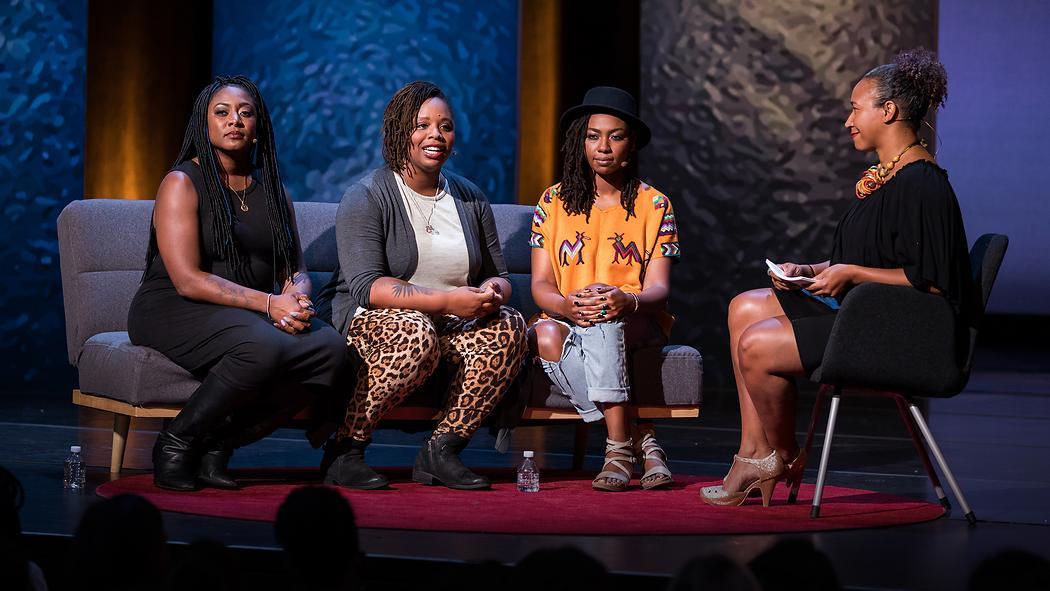
Figure 1. Garza, Cullors, and Tometi are interviewed about BLM by TED.
Ongoing Legacy
Tometi recognized the need for a global platform to highlight Black issues, leading her to launch Diaspora Rising, a digital digest focused on Blackness worldwide. She also served as a trusted advisor and board member for various human rights organizations, frequently traveling internationally to support social justice initiatives.
Alongside her Black Lives Matter co-founders, she received the Sydney Peace Prize and an honorary PhD. She appeared on the covers of major magazines and earned recognition from Forbes, Marie Claire, and Cosmopolitan’s “Most Influential People” lists and TIME’s 100’s Most Influential Women of the Century and TIME’s 100 Most Influential People of 2020.

Figure 2. The BLM co-founders on the Time's Cover for the 100 Most Influential People.
In 2020, she earned the Freedom of the Flame Award from civil rights leaders during the 55th anniversary of the Selma Bridge Crossing. One year later, she received a nomination for the 2021 Nobel Peace Prize. On October 1, 2021, Nigerian Independence Day, Tometi announced that she was changing her name to Ayo to honor her Nigerian heritage (Ayo Tometi). Tometi’s lifelong commitment to racial and immigrant justice continued to inspire global movements for equity and liberation.
 Carry the Torch

Black Lives Matter. “Our History.” Accessed March 12, 2025. https://blacklivesmatter.com/our-history/#:~:text=In%202013%2C%20three%20radical%20Black,Trayvon%20Martin's%20murderer%2C%20George%20Zimmerman.
BlackPast. “Opal Tometi (1984–).” Accessed March 12, 2025. https://www.blackpast.org/african-american-history/tometi-opal-1984/.
Black Women’s Religious Activism. “Ayo Opal Tometi.” Accessed March 12, 2025. https://blackwomensreligiousactivism.org/activists/ayo-opal-tometi/.
Catt Center for Women and Politics. “Address at the United Nations General Assembly, July 12, 2016.” Accessed March 12, 2025. https://awpc.cattcenter.iastate.edu/2018/09/17/address-at-the-united-nations-general-assembly-july-12-2016/.
Catt Center for Women and Politics. “Interview on Black America, April 6, 2017.” Accessed March 12, 2025. https://awpc.cattcenter.iastate.edu/2018/09/27/interview-on-black-america-april-6-2017/.
Catt Center for Women and Politics. “Remarks at the Marching in the Arc of Justice Conference.” Accessed March 12, 2025. https://awpc.cattcenter.iastate.edu/2018/08/31/remarks-at-the-marching-in-the-arc-of-justice-conference/.
East Carolina University. “No More Silence.” February 29, 2016. Accessed March 12, 2025. https://news.ecu.edu/2016/02/29/no-more-silence/.
Influence Watch. “Opal Tometi.” Accessed March 12, 2025. https://www.influencewatch.org/person/opal-tometi/.
Opal Tometi Official Website. “Ayo Opal Tometi Biography.” Accessed March 12, 2025. https://ayotometi.org/biography/.
Opal Tometi Official Website. “Opal Tometi and Black Lives Matter.” Accessed March 12, 2025. https://ayotometi.org/opal-tometi-black-lives-matter/.
Images
Opal Tometi Official Website. “Opal Tometi and Black Lives Matter.” Accessed March 12, 2025. https://ayotometi.org/opal-tometi-black-lives-matter/.
Georgetown Institute for Women, Peace, and Security. “Black Lives Matter Co-Founder Opal Tometi on the Fight for Racial Justice in the US.” Accessed March 12, 2025. https://giwps.georgetown.edu/black-lives-matter-co-founder-opal-tometi-on-the-fight-for-racial-justice-in-the-us/.
TED. “An Interview with the Founders of Black Lives Matter.” Accessed March 12, 2025. https://www.ted.com/talks/alicia_garza_patrisse_cullors_and_opal_tometi_an_int.
TIME. “100 Most Influential People 2020: Black Lives Matter Founders.” Photograph by Kayla Feefer. Accessed March 12, 2025. https://time.com/collection/100-most-influential-people-2020/5888228/black-lives-matter-founders/.
MLA — “Ayo Tometi.” National Women’s History Museum, 2026. Date accessed.
Chicago — “Ayo Tometi.” National Women’s History Museum. 2026. https://www.womenshistory.org/education-resources/biographies/ayo-tometi.
Classroom Resources
Elementary School Bell Ringer: Word association
-
Prompt: Write down three words that come to mind when you hear the phrase “Black Lives Matter”. Then, write one sentence explaining why you chose each word.
-
Follow-up Discussion: What do your words tell us about the importance of the movement?
Middle School Bell Ringer: Reflection
-
Prompt: Opal Tometi helped start the Black Lives Matter movement to make the world a better place. What is one issue you care about, and what is one way you could take action to help? Write 2–3 sentences about how you can make a difference.
-
Follow-up Discussion: Why is it important to stand up for what you believe in?