Amelia Earhart
Amelia Earhart was a trailblazing aviator whose daring feats set records for women in aviation.
She used her fame to support women’s rights in the fields of science and technology and to advocate for legal rights with the National Woman’s Party.
She often wrote about her travels and lectured around the country about the importance of aviation as a field and promoting women’s exploration of aviation.
“Please know I am quite aware of the hazards. I want to do it because I want to do it. Women must try to do things as men have tried. When they fail, then failure must be but a challenge to others.”
Amelia Earhart, before 1937. (LoC)
Early Life and Aviation Training
In her short life, Amelia Earhart became a ground-breaking female aviator, becoming the first woman to fly solo across the Atlantic Ocean, whose international fame improved public acceptance of aviation and paved the way for other women in commercial flight.
Amelia Mary Earhart was born on July 24, 1897, in Atchison, Kansas to Amy Otis Earhart and Edwin Stanton Earhart. She was the oldest of two daughters. Her father came from humble beginnings and worked as an attorney, while her mother was from a more socially prestigious family that prioritized education. Earhart’s mother had an adventurous spirit herself, once solo climbing a Colorado mountain in her youth. She raised her daughters in an unorthodox manner for the time period, letting them wear bloomers instead of skirts and encouraging them to play sports. The family moved from Kansas to Iowa to Minnesota to Illinois, where Earhart graduated from high school.
In a society in which women were expected to prioritize marriage and children over all else, Amelia Earhart wanted to work and live for herself. However, her options were limited. During World War I, she left college to work at a Canadian military hospital. However, she had other passions: aviation (National Geographic).
After the war, Earhart completed one semester at Columbia University, and another at the University of Southern California. Earhart’s attention shifted to aviation when she saw an “air rodeo” in California in 1920. The day following the event, she was a passenger in a 10-minute flight through which she realized her true passion for flying. She urged her parents to let her pursue this passion and began flying lessons with one of the rare female aviators of the time, Neta Snook. On her twenty-fifth birthday, Earhart purchased a Kinner Airster biplane, and in 1922 she set the women’s altitude record of 14,000 feet. With faltering family finances, she sold the plane in 1923. She was licensed by the Fédération Aéronautique Internationale, the International Aviation Federation, and was the 16th woman to gain that honor (National Geographic). When her parents divorced in 1924, Earhart moved with her mother and sister to Massachusetts and became a settlement worker at Dennison House in Boston, while also flying in air shows.
First Transcontinental Flight
Earhart’s life changed dramatically in 1928, when publisher George Putnam tapped Earhart to become the first woman to cross the Atlantic by plane. Putnam was seeking to expand on public enthusiasm for Charles Lindbergh’s transcontinental flight a year earlier, Earhart wanted to fly the plane herself, but due to weather conditions was asked to sit as passenger (National Geographic). Despite this, Earhart became a media sensation and symbol of what women could achieve when the flight from Newfoundland landed in Wales on June 17, 1928, (Primary Source: LoC). Putnam remained her promoter. Earhart married Putnam in 1931, though she retained her maiden name and considered the marriage an equal partnership (LoC).
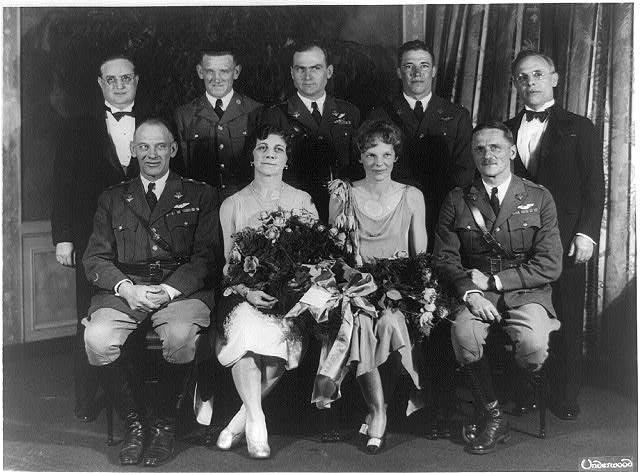
Figure 1. Earhart and group at ceremony, ca. 1928.
Writing and Advocacy
Earhart was sometimes painted by critics to be a daredevil flyer, trying to get famous through risky aerial adventures, rather than a legitimate scientist. In addition to her flights, however, she was an author and educator in the field of science and technology. Earhart published two books in her career. The First, 20 Hrs. 40 Mins. (1928), recounted her experience as the first woman to cross the Atlantic by air and combines memoir anecdotes about her interest in flying with entries from her logbooks. She later published The Fun of It: Random Records of My own Flying and of Women in Aviation (1932), which included personal reflections, logbook entries, and a chapter on other women that Earhart knew in aviation. She often advocated for women’s rights throughout her career, leveraging her fame to argue for women’s capacity for greatness in lectures across the United States.
“Aviation, this young modern giant, exemplifies the possible relationship of women and the creations of science. Although women as yet have not taken full advantage of its use and benefits, air travel is available to them as to men. As so often happens in introducing the new or changing the old, public acceptance depends particularly upon woman to spin the attitude.”
Speech by Amelia Earhart on women’s contributions to aviation, date unknown (LOC).
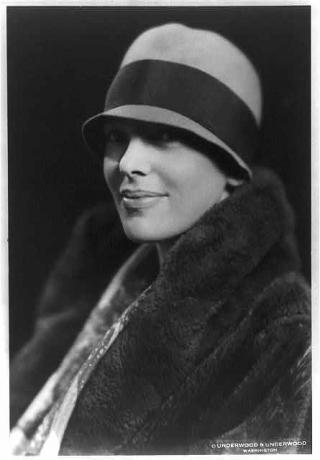
Figure 2. Earhart in 1930.
Earhart’s popularity brought opportunities, from a short-lived fashion business to a stint as aviation editor at Cosmopolitan. She designed functional women’s clothing, especially for air travel, which she promoted herself in her highly photographed public appearances (Smithsonian). It also brought financing for subsequent record-breaking flights in speed and distance. In 1932, she became the first woman to fly solo across the Atlantic as a pilot. Her awards included the American Distinguished Flying Cross and the Cross of the French Legion of Honor.
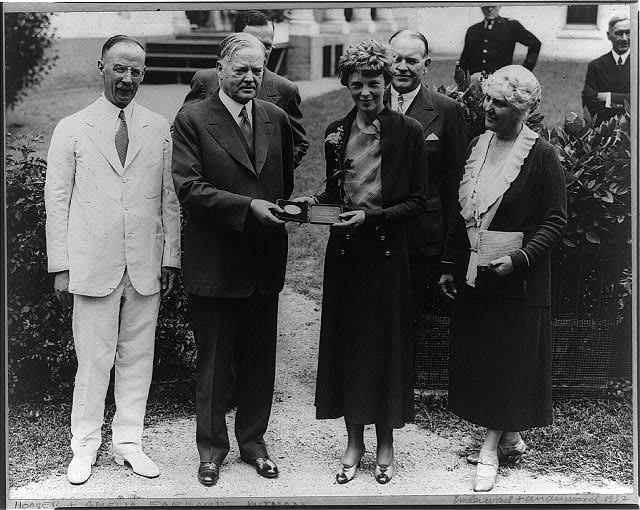
Earhart often advocated for women’s rights, especially in her involvement in the National Woman’s Party. She was a prominent advocate for the Lucretia Mott Amendment, which would become the Equal Rights Amendment, speaking at large public venues and bending the president’s ear on occasion as she was able to (Ms.). She had friends at the height of society due to her fame, especially First Lady Eleanor Roosevelt. The two bonded on their support of women’s advancing roles, and Earhart even once left a dinner at the White House to take a midnight flight with Roosevelt (Smithsonian).
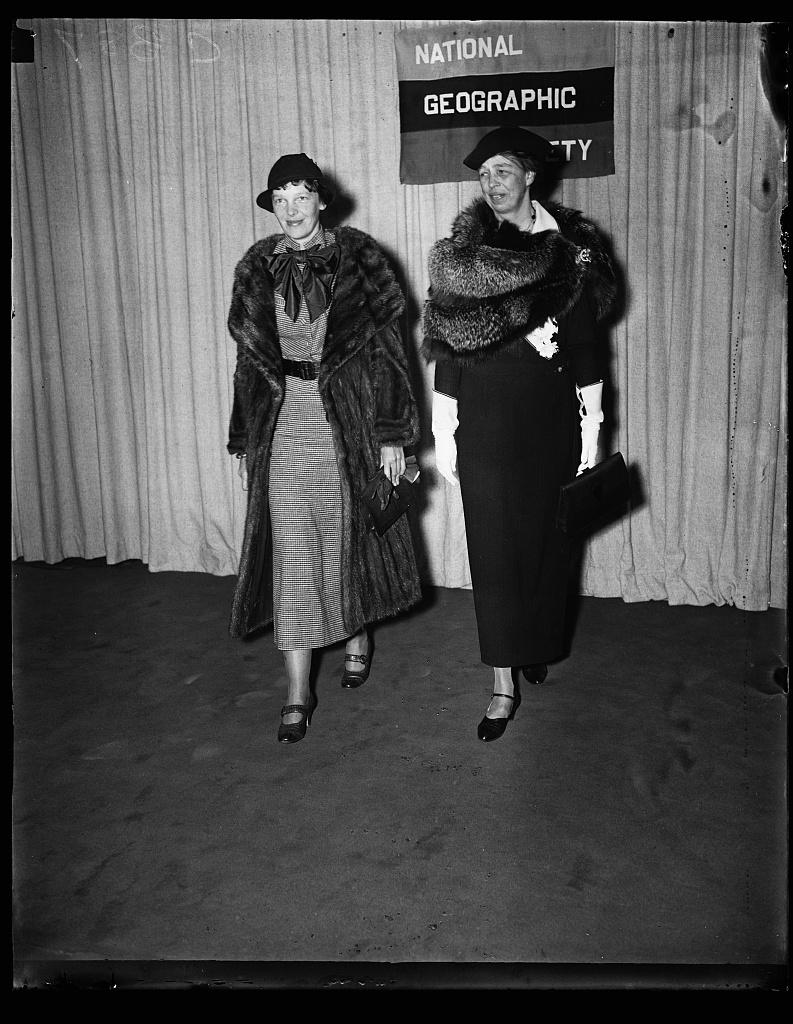
Figure 4. Amelia Earhart and Eleanor Roosevelt, 1935.
Earhart paid particular attention to uplifting other women coming up in the aviation field, often inspired by her image. In 1929, she helped to organize the All-Women's Air Derby, which was the first transcontinental air race for women. That same year, encouraged by the public attention for the air derby, Earhart helped found the Ninety-Nines, an organization of female aviators (Smithsonian). Earhart often publicly supported women’s entry to aviation, often speaking against the prejudice against women in the field and their lack of opportunity to train as pilots.
“Women can qualify in the air as in any other sport. Their influence and approval are vital to the success of. commercial aviation. Women and girls write to me by the thousands to learn the truth about aviation and what women’s-chances are. There is nothing in woman’s make-up which would make her inferior to a man as an air pilot. The only barrier to her swift success is her lack of opportunity to receive proper training.”
- Earhart to Evening Star, 1929. (LoC).
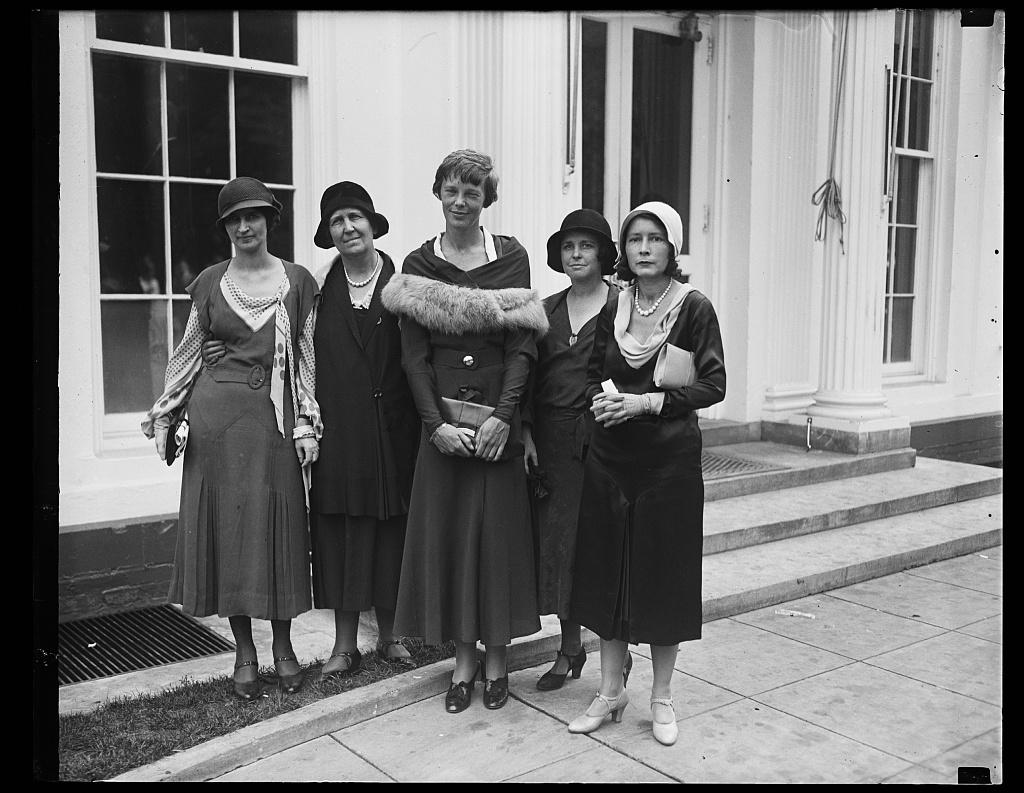
Figure 5. Earhart with members of National Woman’s Party in 1932.
In 1935, Earhart started work at Purdue University teaching engineering and serving as a career counselor for women. There, she purchased the Lockheed plane she dubbed her “flying laboratory.” She often used her flights to perform experiments, such as studies on the effects of fatigue on aviators and the most effective diets for long-haul flights, and to test out efficiency of aviation gasoline (Primary source: LoC).
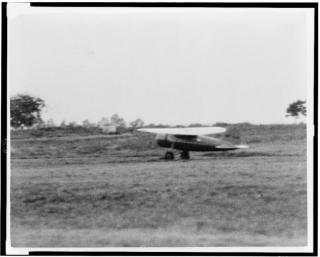
Figure 6. Earhart taking off from Hawaii in solo flight, January 12, 1935.
Final Flight and Legacy
In 1936, Earhart began planning her biggest endeavor yet: she would attempt to become the first woman to complete a flight around the world. On March 17, 1937, after a year of fundraising, she left Oakland, California with navigator Fred Noonan. Technical issues, however, forced them to stop and make repairs in Hawaii. To fund the needed repairs and new flight arrangements, Earhart and Putnam raised enthusiasm for the venture with the proposed publication of World Flight, a book which would include Earhart’s narrative of the trip and notes from her logbook. On June 1, 1937, she left Miami with Noona again for a second try (LoC). The plane lost radio contact near the Howland Islands, with 7,000 miles remaining on the trip. It was never found, despite an extensive search that continued for decades (Primary Source: LoC). Putnam still published Earhart’s book draft, but with the new title Last Flight (1937).
Earhart had often reflected on her motivations for taking such risky flights, with the full knowledge that disaster could strike at any moment. In preparing for what would become her final flight, she wrote a note to her husband Putnam:
“Please know I am quite aware of the hazards. I want to do it because I want to do it. Women must try to do things as men have tried. When they fail, then failure must be but a challenge to others.”
Amelia Earhart, before 1937 (LoC).
The National Woman’s Party, in recognition of Earhart’s contributions to women’s rights, founded the Amelia Earhart Fund for Equal Rights in 1938. She is remembered not only as a daring aviator, but a staunch advocate for women’s rights and the Equal Rights Amendment.
“Immortality lies in the continuation of work, and so it is that the National Woman’s Party seeks to honor its beloved and distinguished member, Amelia Earhart, by giving her name to a fund that gives wings to the cause in which she believed and which she never failed to advance.”
Equal Rights, vol. 24, no. 2 (1938) (LoC).
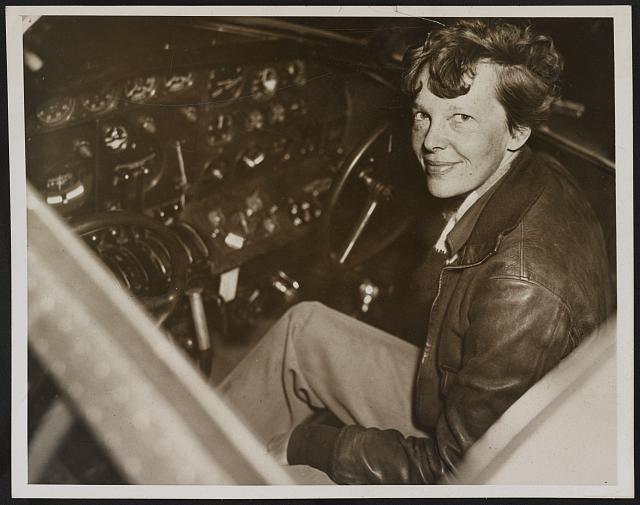
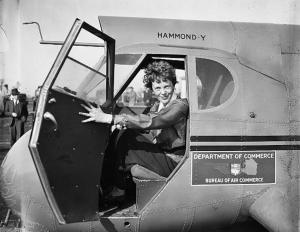
Figure 7. Earhart in airplane cockpit, before 1937.
 Primary Source Analysis Strategies

Primary Source Analysis Strategies
- Listen to this speech by Earhart about women in aviation. What do you think is the “thesis,” or central argument, that Earhart is trying to make?
- What points does Earhart use to make her central argument?
- What do you learn through this speech about women’s lives in the 1930s in America? What role did women have in society, and how might their lives be changing at this time period?
- Do you find Earhart’s speech convincing? Why, or why not?
Newspaper Article: Earhart Advocating for Women in Aviation
- Read this article from 1929 where Earhart advocates for women’s greater involvement in aviation. What reasons does she give as to why women in 1929 did not have equal access to aviation as a career?
- How does the article describe Earhart? What do you learn about her from the description and from her quotes? Are there any potential biases in the writing that you can find?
- What do you learn from this article about women’s lives in the 1920s and 30s?
Figure 7. Earhart in airplane cockpit, before 1937.
- Look at this portrait of Amelia Earhart taken during her career in aviation. What do you notice about the image? What is Earhart doing?
- This image circulated following Earhart’s death in 1937 as a popular portrait of Earhart at work. How is Earhart portrayed in this image?
“Amelia Earhart.” Smithsonian Air and Space Museum. Accessed February 18, 2026.
https://airandspace.si.edu/explore/stories/amelia-earhart
“Amelia Earhart to Seek New Firsts.” Roanoke Rapids herald. (Roanoke Rapids, NC) 10 Sep. 1936, p.
36. Retrieved from the Library of Congress, www.loc.gov/item/2017236974/1936-09-10/ed-1/.
Amelia Earhart: The Official Website. “Biography.” Accessed July 25, 2014.
“Amelia Lost in Pacific South Seas.” The Bismarck tribune. (Bismarck, ND) 3 Jul. 1937, p. 1. Retrieved from the Library of Congress, www.loc.gov/item/sn85042243/1937-07-03/ed-1/.
Blakemore, Erin. “Amelia Earhart’s life is way more interesting than her mysterious death.” National Geographic. May 6, 2025. https://www.nationalgeographic.com/history/article/amelia-earhart-aviation
“Complete Program Transcript, American Experience: Amelia Earhart.” PBS.com. Accessed July
25, 2014.
Dismore, David M. “Today in Feminist History: Amelia Earhart Fights for the Equal Rights Amendment (September 22, 1932).” Ms. September 22, 2020. https://msmagazine.com/2020/09/22/feminist-history-september-22/
“Give Women a Chance in the Air, Pleads Amelia Earhart.” Evening Star. (Washington, DC) 22 Sep.
1929, p. 102. Retrieved from the Library of Congress, www.loc.gov/item/sn83045462/1929-09-22/ed-1/.
Jacobsen, Arnold, and Amelia Earhart. Speech by Amelia Earhart. [Unknown] Audio. Retrieved from the Library of Congress, <www.loc.gov/item/afccal000004/>.
NASA. “Earhart Crosses the Atlantic.” Accessed July 25, 2014.
Rich, Doris. Amelia Earhart: A Biography. Washington, D.C.: Smithsonian Press, 1996.
The Sky’s the Limit: Amelia Earhart and the National Woman’s Party. 2025. Video. Retrieved from the Library of Congress, <www.loc.gov/item/video-10986/>.
Thurman, Judith. “Missing Woman: Amelia Earhart’s Flight.” New Yorker, September 14, 2009.
Ware, Susan. Still Missing: Amelia Earhart and the Search for Modern Feminism. New York: W.W.
Norton, 1993.
“Woman Flier Crosses Atlantic in 21 Hours, Lands on Wales Coast.” The Indianapolis times. (Indianapolis, IN) 18 Jun. 1928, p. 1. Retrieved from the Library of Congress, www.loc.gov/item/sn82015313/1928-06-18/ed-1/.
Zimmerman, Amanda. “The Sky’s the Limit: Amelia Earhart and the National Woman’s Party.” March 6, 2024. Library of Congress. https://blogs.loc.gov/bibliomania/2024/03/06/the-skys-the-limit-amelia-earhart-and-the-national-womans-party/
MLA – National Women’s History Museum. “Amelia Earhart” National Women’s History
Museum, 2026. Date accessed.
Chicago – National Women's History Museum. “Amelia Earhart.” National Women’s History
Museum. 2026. Link.
Library of Congress Amelia Earhart Resource Guide
Earhart, Amelia. 20 Hours, 40 Minutes. G.P. Putnam's Sons. 1928.
Earhart, Amelia, The Fun of It. Harcourt, Brace and Company. 1933.
Butler, Susan. East to the Dawn: The Life of Amelia Earhart. Da Capo Press: Cambridge, Massachusetts, 1997.
Fleming, Candace. Amelia Lost: The Life and Disappearance of Amelia Earhart. New York: Swartz &
Wade Books, 2011.
Lovell, Mary. The Sounds of Wings. New York, New York: St. Martin's Press, 1989.
Bessie Coleman

This biography is sponsored in part by the Library of Congress Teaching with Primary Sources Eastern Region Program, coordinated by Waynesburg University. Content created and featured in partnership with the TPS program does not indicate an endorsement by the Library of Congress.
For further information or questions, please contact [email protected].
Eleanor Roosevelt