
The Rollins Sisters: Queens of the South
Grade Level
8–12
Subject Area
Reconstruction, Suffrage, Civil Rights
Related Documents
Download Full Lesson Plan +
Reconstruction established a new political and social environment in South Carolina. Sisters from Charleston, made their way to Columbia after the Civil War and became participants in the reform of government and society during the 1860s and 1870s. The Rollin’s influenced reform during Reconstruction through their work with state officials, their family connections and the operation of a political salon across the street from the state capital.
Essential Question
To what degree did Reconstruction change the role of African American women in the South?
50–75 Minutes
Learning how the Rollin’s influenced reform during Reconstruction through their work with state officials, their family connections and the operation of a political salon across the street from the state capital.
Vocabulary
Reconstruction
Suffrage
Colored
Mulatto
Ku Klux Klan
Boarding
Clerk
Primary Sources
Rollin Sisters, South Carolina Encyclopedia
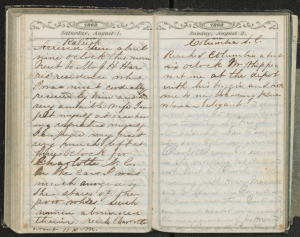
Diary of Frances Anne Rollin
(pg. 114–121)
To Exercise the Same Privileges
The Queens of the South, March 29 1871
Additional Resources
Graphic Organizer Source 1
Graphic Organizer Source 2
Graphic Organizer Source 3
Graphic Organizer Round 2
Warm Up
See Warm Up Sheet. Briefly describe the Rollin sisters to the class.Create groups of three. Show the class the following headline from an 1871 New York newspaper article. Ask groups to discuss:
- What does the headline suggest about the power of this family?
- Why might this story be interesting to a New York audience?
- What do you want to know about the Rollin sisters?
Ask group members to share their answers to the questions.
Students will read the short biography about the Rollin Sisters from the South Carolina Encyclopedia and then answer the following questions in a brief whole class discussion:
- What did you find interesting and/or unique about the Rollin sisters?
- How do their lives confirm or challenge what you know about African American women living in the South during Reconstruction?
- What would you still like to know about them?
Student groups will create three questions to guide their investigation of the primary sources on the Rollin Sisters.
Questions & Activities
Sources & Questions
Source 1
Diary of Frances Anne Rollin 1868
Source 2
To Exercise the Same Privileges 1869
Source 3
The Queens of the South March 1871
Supporting Question 1
What does Frances Rollin’s diary reveal about the roles of African American women during Reconstruction?
Supporting Question 2
Which of Charlotte Rollin’s arguments for suffrage may have been the most persuasive in 1869? Why?
Supporting Question 3
What made the Rollin sisters influential in Reconstruction politics in South Carolina?
Primary Source Jigsaw
Hand out copies of the primary source set to each group.
Source 1
Diary of Frances Anne Rollin 1868
Source 2
To Exercise the Same Privileges 1869
Source 3
The Queens of the South March 1871
Hand out copies of the primary source analysis sheets to each group.
- Source 1
- Source 2
- Source 3
Students should check to make sure their source matches the analysis sheet.
Students should read their source and complete their analysis sheet.
After completing their analysis for their assigned document, students should share their findings with the group.
Student groups will then complete the Round 2 analysis sheet as a group.
Student groups will then share their analysis and answer to the compelling question in a whole group discussion.
Formative Assessment
Completed individual primary source analysis sheet and group source analysis sheet.
Summative Assessment
Students will answer the following prompt:
Frances Rollin Whipper’s diary ends at the beginning of 1869. Based on what you have read and learned about the Rollin Sisters, use at least two sources to create an entry (2–3 paragraphs) for her diary in January 1877. Describe the impact of her family on civil rights for the women of South Carolina.
Modification
- Primary sources can be excerpted and/or key passages highlighted to assist students in identifying key ideas or arguments.
- Pre-read primary source documents and create a vocabulary support sheet.
- Create sentence starters for writing prompts.
- Model completing the graphic organizer for Document 1.
- Assign roles for collaborative group work.
- Provide opportunities for pre-writing, checklist and rubric.
- Ask advanced learners to research other influential women during this era and compare their experiences.
Extension Activities
Watch the Documentary Sisterhood: South Carolina Suffragists —The Rollin Sisters — Reconstruction Through 1895
Additional Resources
Columbia City of Women Honoree
The Rollin Sisters
by City of Women
PBS
Sisterhood: South Carolina Suffragists —The Rollin Sisters — Reconstruction Through 1895
by SCETV Specials
Teacher Notes
- The Rollin sisters were born into a free black family in Charleston that owned slaves.
- William Whipper was a delegate to the 1868 South Carolina Constitutional Convention.
Dimension 2 — Change, Continuity and Context
D2.His.2.9—12. Analyze change and continuity in historical eras.
D2.His.3.9—12. Use questions generated about individuals and groups to assess how the significance of their actions changes over time and is shaped by the historical context.
Dimension 3 — Evaluating Sources and Using Evidence
D3.1.9—12. Gather relevant information from multiple sources representing a wide range of views while using the origin, authority, structure, context, and corroborative value of the sources to guide the selection.
Dimension 4 — Communicating Conclusions and Taking Informed Action
D4.1.9—12. Construct arguments using precise and knowledgeable claims, with evidence from multiple sources, while acknowledging counter claims and evidentiary weaknesses.