
Rock the Boat: Finding Your Voice in Poetry
Grade Level
4th • 6th
Subject Area
Social Studies or Media Studies
Related Documents
Download Full Lesson Plan +
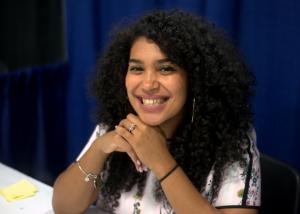
In this lesson, students explore Elizabeth Acevedo’s poem Rock the Boat and Langston Hughes’ poem Mother to Son as mentor texts to notice how poets use language and structure to express ideas about community and perspective. Students reflect on their own experiences and values, discuss what it means to be an upstander, and then create original poems that express issues or ideas important to them.
Big Ideas
Students can use published poems as models to notice how the poet shared ideas about helping their community and making change. They can use what they learn to help write their own poem.
80–90 Minutes*
- Students will use Elizabeth Acevedo’s Rock the Boat and Langston Hughes’ Mother to Son as mentor texts to identify how poets convey ideas about community and change.
- Students will analyze language, structure, and poetic strategies to inform their own writing.
*Can be split into two days.
EssentialVocabulary
Elizabeth Acevedo
Langston Hughes
Stanza
Upstander
Metaphor
Primary Sources
Interview of Elizabeth Acevedo on Cuénteme. Library of Congress.
Langston Hughes reading his poems with comment. Library of Congress (The poem starts at 34:07 and ends 34:50).
Biographies
Elizabeth Acevedo Biography. Library of Congress.
Poems
Rock the Boat by Elizabeth Acevedo. Poem.
Mother to Son by Langston Hughes. Poem.
- Launch: Students use scenarios to define upstander and discuss themes relevant to the two mentor poems
- Background Knowledge: Analyze a short video of Elizabeth Acevedo discussing her literary journey, including how the library inspired her and her belief that poetry is shaped by both the poet and the reader.
- Reflection: Students reflect on their own relationship with poetry and what poetry means to them.
- Framing: Introduce Acevedo’s poem Rock the Boat as a mentor text about creating change and being an upstander in one’s community.
- Two Reads: Guide students through two readings of the Acevedo poem:
- First Reading Part 1: Literal Understanding—The teacher will focus on the surface level, reading comprehension, of the poem. At this stage, students should be figuring out the main idea of each stanza.
- First Reading Part 2: Overall Message—Students review the literal understandings to create a sentence statement about what is the author’s overall message.
- Second Reading: Poetic Language and Structure—Students re-read the poem to look for literary language and structure.
- Have students star or highlight an element of literary language or structure they want to try out later.
- Two Reads: Guide students through two readings of the Hughes poem:
- First Reading Part 1: Literal Understanding—The teacher will focus on the surface level, reading comprehension, of the poem. At this stage, students should be figuring out the main idea of each stanza.
- First Reading Part 2: Overall Message—Students review the literal understandings to create a sentence statement about what is the author’s overall message.
- Second Reading: Poetic Language and Structure—Students re-read the poem to look for literary language and structure.
- Reflection: Students brainstorm the intersection between themself and the poem. Students consider the poem’s ideas, and their own experiences, beliefs and values connected to their community.
- Creative Writing: Students will craft a draft of their own poem about an issue important to them, using Acevedo’s poetic strategies as inspiration.
Warm-Up
7 minutes
Students will use the three scenarios to help discern the meaning of upstander. To personalize the examples, you can change the names of the upstanders to their students. Consider also changing the examples to reflect positive actions of your students to reinforce upstanding behavior in your classroom.
The purpose of question one is to give students language to help understand the message of Elizabeth Acevedo’s Rock the Boat. Question two reflects the type of thinking students will do after reading Langson Hughes’ Mother to Son, connecting the idea of being an upstander (Acevedo) to the courage and persistence in Hughes’ poem. By starting with some big picture thinking related to their own lives, students will be more primed to think about the themes in the poems.
Read the situations below. Use the scenarios and your own ideas to answer questions 1 and 2 below.
- During group work, Sam noticed that Maya was being ignored by the other group members. She kept looking down at her paper and twisting her pencil. Sam asked, “Maya, what do you think?” Maya shared a quiet idea about the project. Same smiled and said it was a really good idea. After more discussion, the group decided to use it.
- During lunch, Lina noticed a new student sitting alone at the end of the table. The student kept looking around but did not talk to anyone. Lina had remembered feeling like that when she was new a few years ago. Lina walked over and asked, “Do you want to sit with us?” Lina helped carry the new student’s lunch over to where Lina’s friends were sitting. Lina and her friends asked friendly questions and listened. The new student smiled and relaxed.
- In class, a student gave a wrong answer during a math lesson. A few kids giggled and looked at each other. Marcus raised his hand and reminded his friends, “It’s ok to make mistakes. That’s how we learn.” The teacher nodded and thanked him. His friends frowned sheepishly, becoming more respectful.
Question One
Sam, Lina, and Marcus all were upstanders in school. What might an upstander be?
Potential Answers
- An upstander is someone who notices when a person is being left out and speaks to include them
- An upstander is someone who uses their voice to stop unkind or unfair behavior, big or small.
- An upstander uses their voice or action when something is unfair, instead of staying silent.
Question Two
Stretch your thinking: How does being an upstander relate to courage or persistence?
Potential Answers
- It can be uncomfortable to be an upstander. You might need to use your courage to help you use your voice.
- Upstanders work through small and big problems, both might need persistence because they’re not easy to change.
Background Knowledge
5 Minutes
Show students the Library of Congress primary source interview of Elizabeth Acevedo on Cuénteme. Before playing the video, say to students: Elizabeth Acevedo is an Afro-Dominican American poet. In 2022, she was named the Young People’s Poet Laureate, an award given out only every two years. It’s for writers that create meaningful and exceptional poetry for young people. Acevedo has written many stories made from poetry verse that speak to belonging, family, and community. We’re going to use her poetry and another poet’s poetry today to help us think and write more deeply about our own sense of belonging and community. (The Library of Congress biography).
Listening/Watching Focus Question
- Start at 2:26 (start at Meg Medina asking “what were you like as a teen?”)
- End at 4:50 (end at: “they want to find pathways towards understanding family”)
What shaped Elizabeth Acevedo’s connection with poetry and writing growing up?
Have students share with a partner so they have a chance to build ideas before the whole class discussion.
Points Acevedo Names:
- She identifies as a reader.
- She loved the library and her books.
- Books created other worlds for her.
- She tried different ways of writing from songs to poetry, which helped her express her ideas.
- It gives her/readers a way to understand themselves. It’s a way to understand family.
Application to Self
What has shaped your connection to poetry?
Have students jot down their ideas. You can have the students pair-share, and then reflect back to the students key ideas heard during pair-shares. Alternatively, you can move from individual writing processing to a short whole-group share-out.
Direct Instruction
Mentor Text 1
15 Minutes
First Read Elizabeth Acevedo’s Rock the Boat poem together as a class.
You should read aloud for the first read. In this way you can use your voice to emphasize key points and model the cadence of the poem. Students can be unfamiliar with the concept of intentional splitting up of ideas in poems onto different lines to emphasize a point. You can help prime this thinking through your reading aloud and how you pause at the end of a line.
At the end of reading, have students annotate each stanza for the main idea. The purpose of this step is to help students zoom in so they can better piece together the poem. Say: A stanza is a group of lines in a poem. What does each stanza mean?
Have students pair-share with a partner to annotate on the poem directly. For the whole class debrief, have a copy of the poem on screen.
Stanza 1: People may tell you not to create change when they are afraid of change
Stanza 2: You might feel that staying quiet is not right
Stanza 3: You might feel your body tightening up as you want to speak out
Stanza 4: It is not easy to rock the boat
Stanza 5: Practice speaking out
Stanza 6: Speaking up might make your body feel nervous but trust that it’s right
Stanza 7: Even if it’s hard, rock the boat
Stanza 8: Sometimes you might feel alone in speaking out
Stanza 9: Don’t be quiet; rock the boat
Stanza 10: You and your voice is powerful
Stanza 11: Rock the boat
Say to students that they just zoomed in on the meaning to build understanding. Now, you’re going to zoom out to think of what Elizabeth Acevedo was trying to communicate. You’re going to use your partner and the poem to come up with a 1-sentence message. What is the message of the poem?
- Sometimes standing up to others can be hard or uncomfortable, but it is important we do so
- Our voice is powerful and can make change. Therefore it is important we use our voice to create positive change.
If you notice while circulating that students generally understand the message, you can move directly from partner work to the second read. This can help build momentum if they’ve already built consensus, so they’re onto the next challenge in thinking.
Guided Practice
10 Minutes
Second Read of Acevedo’s Poem
Say: A metaphor is a comparison between two things. It’s when a writer says one thing is another thing to help you picture it better. For example, what might I really mean if I say ‘a classroom is a zoo’?
(The classroom is crazy or loud).
If your class has a practice of note-taking, they can add the definition of metaphor to their notes. Alternatively, you can have a slide or visual of this for students to refer back to during discussion later.
Say: In this poem, Elizabeth Acevedo uses metaphors to craft her point. Where does she use metaphors and what do they mean? We’ll listen for this as we re-read.
In this second read, to continue building student investment, have students read the stanzas. If you do this, I recommend assigning students stanza numbers and have the star their stanza they’ll read to encourage more seamless reading of the whole poem.
Have students pair share prior to class discussion. Students should annotate metaphors in the poem. Where does she use metaphors and what do they mean?
‘Rock the Boat’—used to describe Acevedo’s prompting to be an upstander
‘You contain waves, you are an ocean’—the inner power of the reader to create change
‘Let the tide inside you, shake every single ship, that would attempt to sweep someone beneath’—the person’s ability to push against unfairness
‘With love and hope, rock the boat’—This is another iteration of the ‘rock the boat’ metaphor. It’s about creating change with care towards others
Differentiation Up: What do you notice about the structure of the poem?
(For a more pointed question for students new to poetic structure, you can ask What do you notice about the use of repetition? About line breaks?)
- Each line is a new idea or different thought on the same idea
- Line breaks help Acevedo control our pace of reading, emphasize important words, and shape meaning and emotion.
- The line breaks and repetition help Acevedo tell us what to notice
Direct Instruction
Mentor Text 2
10 Minutes
Langston Hughes’ Mother to Son
Say: Langston Hughes was an African American poet and writer of the 1920s. He moved to Harlem, New York City, in a time considered the ‘Harlem Renaissance.’ Black writers and artists created music, literature, and theater celebrating Black culture. Hughes was a famous writer who wrote about similar themes to Acevedo: belonging, community, and persistence. We’re going to listen to Langston Hughes read his poem to us, as we try to figure out what he’s meaning. (The poem starts at 34:07 and ends 34:50)
There is only one stanza in this poem. It could be helpful to divide this poem into three ‘sections,’ the first chunk ending after ‘bare’ and the second ending after ‘Where there ain’t been no light.’ This will help students get a better understanding of the literal meaning. At the end of reading, have students annotate each ‘section’ for the main idea.
Use this question to prompt them: What does each ‘section’ of the poem mean?
Section 1: Life hasn’t been a ‘crystal stair,’ but has a lot of difficulties along the way
Section 2: I keep on climbing, even when it’s dark
Section 3: Don’t pause, but keep going
Guided Practice 2
7 Minutes
Tell students that they’re going to re-read the poem and think about HOW Langston wrote it. Share the focus question with them before reading so they can think about it while reading.
Say: Where does Langston Hughes use metaphors and what do they mean?
‘Life for me ain’t been no crystal stair’—comparing life to a staircase; life isn’t easy or smooth
‘It’s had tacks in it’ ‘and splinters’—there are obstacles and problems in life
‘Places with no carpet on the floor’ ‘bare’—being without resources or comfort
‘I’se been a-climbin’ on’—He continues to push through and persist
‘Reachin’ landin’s’—getting to small successes or rest
‘Turnin’ corners’—changes in life
‘Sometimes goin’ in the dark’ ‘where there ain’t been no light’—a feeling of hopelessness or the unknown
‘Don’t you set down on the steps’ ‘Don’t you fall now’—don’t stop or give up
Differentiation Up: What do you notice about the structure of the poem?
(For a more pointed question for students new to poetic structure, you can ask: What do you notice about the use of repetition? About line breaks?)
- Each line is a new idea or different thought on the same idea
- Line breaks help Hughes control our pace of reading, emphasize important words, and shape meaning and emotion.
- The line breaks and repetition help Hughes tell us what to notice
Independent Practice
Students Independently Brainstorm
Use the questions below to help students brainstorm their poems. Use pair shares throughout the brainstorm as needed to help as a scaffold when students might feel stuck. You can normalize that feeling of being stuck by naming that it’s ok, and then refer them back to their tool kit: talk to a partner, refer back to their poems, or check-in with a teacher.
Say: What are important issues your community has changed or are working on changing? Focus on issues that you feel connected to.
Stretch It: After students have thought about an issue to be in the message of their poem then prompt: What might be a metaphor for that issue? You can draw or write it.
Summarizer
One of the beautiful elements of poetry is the interaction between the poet and the reader. Have a peer read your poem. It’s ok if it’s unfinished! We learn from initial thoughts just as we learn from final drafts. Read your peer’s poem. Reflect back verbally or writing:
- What is the poet’s message for/about the community?
- What are glows (strengths) in how they crafted the poem?
The teacher could extend the learning from this lesson in a number of ways:
- Students finish their draft of the poem
- Students create a final draft for homework for the classroom. Encourage the students to draw an image to illustrate the message of their poem.
- Differentiation Up: Students reflect on their poem. Craft a response answering the questions:
- What figurative language techniques did you use? Highlight where you used them. Why did you choose to use them there?
- What literary structure techniques did you use? Highlight where you used them. Why did you choose to use them there?
Modification & Accommodation
- In reading the poetry, it’s important to dual code, or have students hear and read the text. They should have print-outs or the text available on a shared screen while the poem is being read aloud.
- When students are brainstorming their own poem, allowing students to draw instead of write the metaphor can help students who feel stuck or are less sure when it comes to their idea in writing. Drafting and annotating a drawing can serve as a brainstorming tool.
Extension & Enrichment Activities
You can extend the learning using the homework to build in poetry writing and review into the class period. See the assessment/homework section.
C3 Framework Standards Addressed
D1.2.3—5. Identify disciplinary concepts and ideas associated with a compelling question that are open to different interpretations.
D1.1.3—5. Explain why compelling questions are important to others (e.g., peers, adults).
D2.Civ.10.3—5. Identify the beliefs, experiences, perspectives, and values that underlie their own and others’ points of view about civic issues.
