
Joan Baez
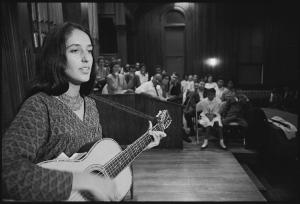
A leading figure in the American folk music revival of the 1950s and 1960s, Joan Baez’s career has spanned decades of music and activism.
Baez has blended her pacifist beliefs with her distinctive musical talent to become an influential advocate for social, political, and human rights.
Baez continues to reference her Mexican heritage through her bilingual music practice, as she has done since the beginning of her career.
“I am not a saint. I am a noise. I spend a good deal of my time singing, dancing, making a nuisance of myself. I love to be the center of attention, and pardon my conceit, I usually am.”
Joan Baez, age 13
Early Life
Joan Chandos Baez was born in Staten Island, New York, on January 9, 1941, to Albert Baez, a physicist from Puebla, Mexico, and Joan Bridge Baez, from Edinburgh, Scotland. She was the second of three sisters, Pauline and Mimi. Her parents raised their children in the Quaker church, teaching them the values of pacifism and civil disobedience.
At age thirteen, Baez first experienced racism in the classroom because of her Mexican heritage. She frequently defended herself but felt ostracized by her classmates and teachers. This discrimination contributed to her developing anxiety. To cope, Baez took refuge in music, which had been a constant in her childhood, by singing and playing a ukulele at lunchtime and harmonizing with her sister Mimi.
Discovery and Folk Music Performance
Joan Baez performing “Plasir D’Amour” in first TV performance on CBS in 1960.
After finishing high school in 1958, Baez briefly attended Boston University when her father moved the family to the area to teach at the Massachusetts Institute of Technology. She soon left the university after discovering the folk music scene that thrived in the Harvard Square coffeehouses. She became a regular performer at Club 47 in Cambridge and quickly developed a following for her clear soprano voice and emotionally powerful renditions of folk classics. Folk artist Bob Gibson invited her to perform at the Newport Folk Festival in 1959, cementing her claim to fame at the age of 18. She received a record contract from Vanguard in 1960 and became an icon in American folk music.
Joan Baez performing “Silver Dagger,” 1965
According to Baez, both her father and her sister, Mimi, were jealous of her immediate success in the music industry. Mimi harbored resentment towards Baez because she hoped to pursue her own music career but struggled to live in her famous sister’s shadow. In addition, the demands of touring, the technical difficulty of her show, and her fame at a young age made her feel isolated. In a yearlong sabbatical from performing, Baez began a relationship with a woman named Kim. She continued to shape her image as a folk icon, walking barefoot and dancing in the streets.
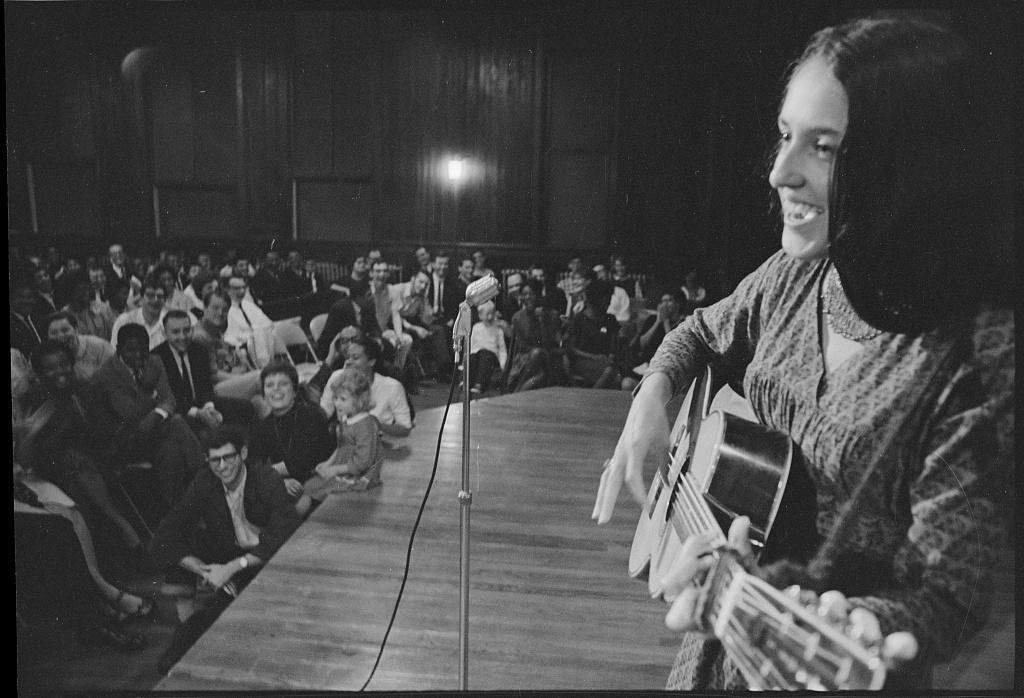
Figure 1. Joan Baez performs for an integrated audience in Mississippi, 1964.
In the early 1960s, Baez began to consider a more public role in political activism, building on the civil disobedience and pacifist values she had learned in childhood. Bob Dylan played an essential role in this shift. Baez met Dylan just as he was establishing his reputation as a writer of protest songs. Baez was impressed by the strength of his socially conscious lyrics and began to include his music in her own performances. At the height of their collaboration, they performed together at the March on Washington for Jobs and Freedom on August 28, 1963, where they sang ‘We Shall Overcome.’
“I was smart enough to know that ‘We Shall Overcome’ did not mean in this lifetime, so I was dug in. I knew this was going to be a long battle.” - Joan Baez, Interview with CBS, 2023.
Joan Baez and Bob Dylan performing “We Shall Overcome” at the March on Washington
Baez and Dylan ended their relationship in 1965, but Baez continued to collaborate with him musically and recorded more of his songs in her later albums. She continued her social justice work throughout the 1960s, marching alongside Martin Luther King Jr., supporting César Chávez in the fight for migrant worker rights in California, and founding the Institute for the Study of Nonviolence.
Vietnam War and Human Rights Activism
In the late 1960s, Baez became active in anti–Vietnam War demonstrations and was arrested in 1967 in Oakland, California, for protesting at the Armed Forces Induction Center. While serving her month-long sentence in prison, she met fellow antiwar protester David Harris, whom she married in March 1968. They later collaborated on antiwar demonstrations, with Harris giving speeches and Baez performing.
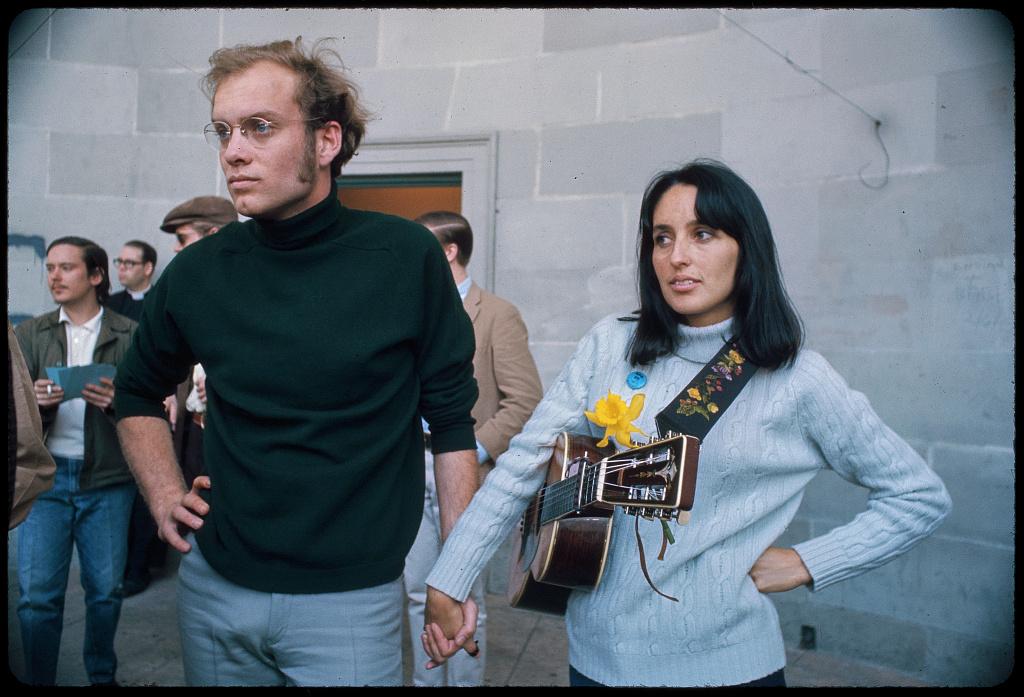
Figure 2. Joan Baez with husband David Harris at an anti-draft demonstration in NYC, 1968.
Shortly after their marriage, Harris refused the draft, which led to his arrest. While pregnant with their son, Gabriel, Baez continued her work to raise awareness of the antiwar movement. In 1972, Baez traveled to North Vietnam with a peace delegation, where she witnessed human rights violations firsthand. She founded Humanitas International and helped establish an American branch of Amnesty International. Harris’s continued imprisonment for refusing the draft strained their relationship, and the couple divorced in 1973.
“For me, somebody who wanted to be a perfect wife and perfect mother, none of it really was possible... the 1:1 was too difficult. The 1 on 2,000, not so bad!” - Joan Baez, Interview with CBS, 2023.
Baez continued to advocate for human rights worldwide, especially in Latin America and Spain. In solidarity with those oppressed under Francisco Franco’s dictatorship, she refused to perform in Spain until after his death. In 1977, Baez performed her first concert in Spain where she sang anthems of resistance that the Spanish government had once prohibited in the country. Baez went on to perform a series of concerts sponsored by Amnesty International in the 1970s to support Chileans suffering under an authoritarian regime.
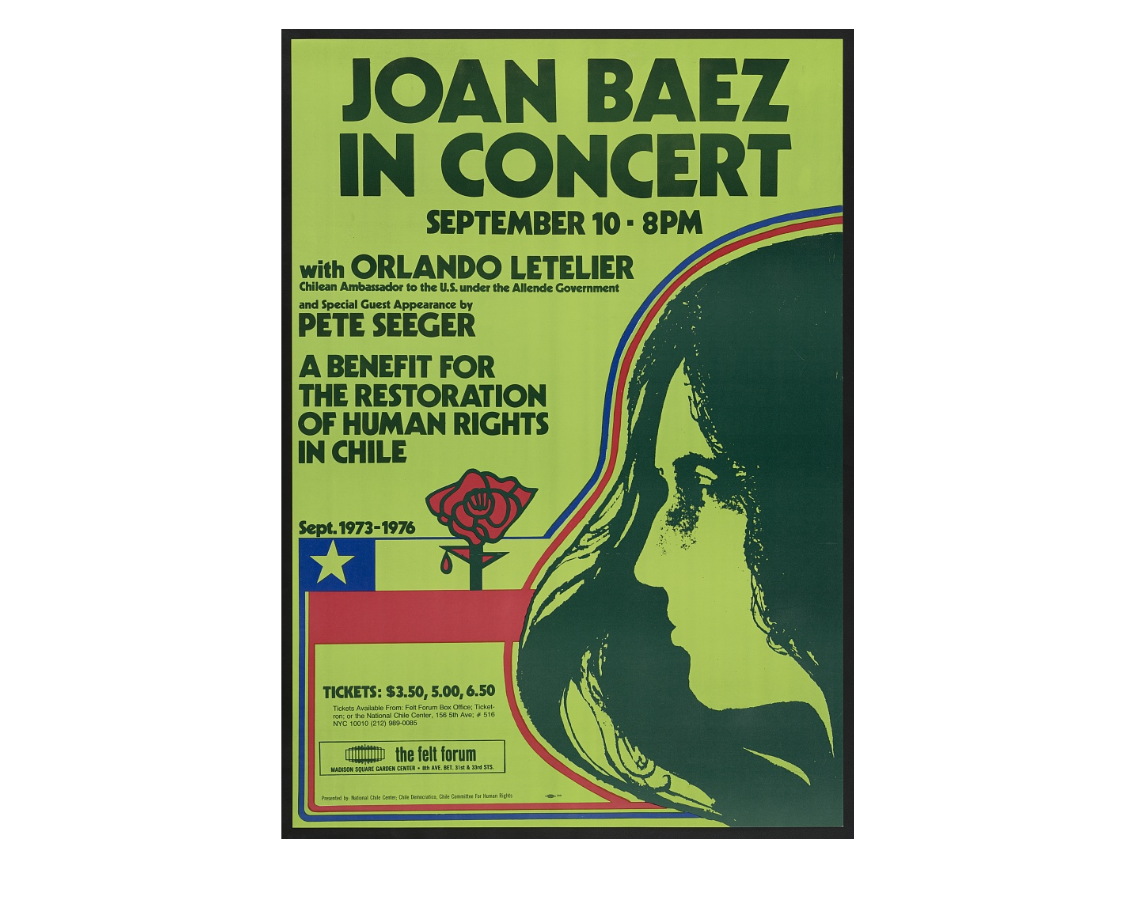
Figure 3. Poster from Joan Baez concert for human rights in Chile, 1973.
Continuing Music and Advocacy
Baez has recorded Spanish-language music throughout her career as an artist. Her Spanish works include “El Preso Numero Nueve” on her debut album Joan Baez (1960) and “Dida” on Diamonds and Rust (1975). In 1974, she released a full album in Spanish titled Gracias a La Vida. Much of Baez’s humanitarian attention during this period focused on Latin America, reflecting her longstanding sense of connection to her heritage as a Latina woman. She has also achieved unprecedented fame for a Latina singer of her time, never shying away from her heritage and using her voice to speak for the causes she cares about.
Joan Baez, “Gracias a la Vida,” 2020.
Baez continued to release music throughout the 1980s and 1990s and performed around the world at humanitarian concerts and events. She continued to record and tour, often with her son Gabriel, who is a percussionist, until 2019. Her awards and honors include a Lifetime Achievement Award at the 2007 Grammys, the inaugural Amnesty International Joan Baez Award for Outstanding Inspirational Service in the Global Fight for Human Rights, the Amnesty International Ambassador of Conscience award, Kennedy Center Honors, and the John Steinbeck Award for civil rights activism. She was inducted into the Rock and Roll Hall of Fame in 2017. She published her first book in 2009, titled And a Voice to Sing With: A Memoir, and a second book in 2024, a poetry anthology titled When You See My Mother, Ask Her to Dance.
“My voice is my greatest gift…the second greatest gift was a desire to use it.” - Joan Baez, Induction into Rock and Roll Hall of Fame, 2017.
 Works Cited

Baez, Joan. Interview with the Library of Congress. August 4, 2020. https://www.loc.gov/static/programs/national-recording-preservation-board/documents/JoanBaezInterview.pdf
Baez, Joan. Interview with CBS Sunday Morning. October 1, 2023. https://www.youtube.com/watch?v=0aY2WyqHKPU
Chiappano, Alessandra, Lia Del Corno. “Joan Baez.” Enciclopedia delle donne. Accessed October 9, 2025. https://www.enciclopediadelledonne.it/edd.nsf/biografie/joan-baez
Ingraham, Cheryl. “Celebrating Joan Baez: A Journey through the Library’s Digital Collections.” Library of Congress. March 31, 2021. https://blogs.loc.gov/ofthepeople/2021/03/celebrating-joan-baez-a-journey-through-the-librarys-digital-collections
Jaeger, Markus. Popular Is Not Enough: The Political Voice of Joan Baez: A Case Study in the Biographical Method. Hannover: Ibidem, 2021.
O’Connor, Karen, Maeve O’Boyle, Miri Navasky, and Joan Baez. Joan Baez. San Francisco, California, USA: Magnolia Pictures, 2025.
Trigg, Mary K. “Joan Baez,” in Great Lives from History: American Women. Salem Press: Hackensack, NJ, 2016. Pg 66-8.
Classroom Resources
Lesson Plan: Songs of Protest
Related Biographies & Profiles
How to Cite this Page
MLA – National Women's History Museum. “Joan Baez.” National Women’s History Museum, 2025. Date accessed.
Chicago – National Women's History Museum. “Joan Baez.” National Women’s History Museum. 2025. https://www.womenshistory.org/education-resources/biographies/Joan-Baez.