Jane Fonda

Jane Fonda is a two-time Academy Award–winning actress known for her long-standing activism.
Since the 1960s, she has supported civil rights, environmental causes, and racial justice.
She has consistently used her fame and talent to advocate for social and political change.
Her outspoken opposition to U.S. involvement in the Vietnam War brought her national attention and controversy, shaping her career in both positive and challenging ways.
“Activism is joy-filled. It’s fun. You feel good knowing that you’re doing everything you can, you've put your whole body on the line.”
Fonda to Stephen Colbert of The Late Show regarding her life of activism.
Background and Early Activism
Despite being the daughter of acting legend Henry Fonda and socialite Frances Seymour, Fonda’s childhood was not easy. At the age of 12, Fonda’s mother committed suicide, which quickly led to her father becoming emotionally distant. As a teenager and young adult, Fonda found herself with the difficult task of forging her own way through the world. As a result, she developed a strong sense of emotional independence. Her independent nature contributed to her strong self-will as she entered the dual worlds of Hollywood and activism.
Living in France for most of the 1960s, Fonda found herself watching American social movements unfold from afar. As these movements began escalating in the latter half of the decade, most notably the anti-Vietnam War and Civil Rights Movements, Fonda was inspired to return to the United States and dive into activism. One of her earliest activist moments was in 1969, when she visited a group of Native Americans who were occupying Alcatraz in San Francisco. During this period, Fonda also became closely associated with the Black Panthers and found herself under the government's eye.
It is from this context that Fonda’s activism against the Vietnam War emerges and becomes a defining characteristic of Fonda's celebrity. One of her most iconic pictures is her mug shot from 1970, taken after she was arrested while returning from an anti-Vietnam War speaking tour in Canada. Though she was arrested under suspicion of drug trafficking, many speculate that her arrest was a direct result of her disagreement with the Vietnam War. Fonda's disagreement with the war would soon land her at the center of public discourse following her 1972 visit to Hanoi.

Figure 1. Jane Fonda mug shot, Cleveland State University. Michael Schwartz Library, Special Collections. 1970.
Activism in the Vietnam War
During her visit to North Vietnam, which would prove to be career-defining, Fonda broadcasted anti-war messages from North Vietnam to American soldiers fighting in the South. Fonda was openly and passionately against American military policies, and her broadcast messages did not hold back. While visiting Hanoi, Fonda also visited hospitals, schools, and war museums in her attempt to better understand the tangible impact that American involvement was having on the North Vietnamese people.
“You were not born and brought up by your mothers to be killers. We must all try very, very hard to remain human beings.”
Jane Fonda to American soldiers fighting in the Vietnam War.
As previously mentioned, Fonda had drawn the government's attention as early as 1970 through her support of the Black Panthers. While her outspoken advocacy fanned the flames of this tension with the government, it was the infamous photograph of Fonda sitting on a North Vietnamese anti-aircraft bomber appearing to aim at American planes, however, that caused this disdain to spread amongst the general public. In fact, this single photograph became a defining symbol of Fonda’s career, for better or for worse, amongst the American people. Fonda’s new nickname, “Hanoi Jane,” became widely known and was accompanied by accusations of treason against the United States.
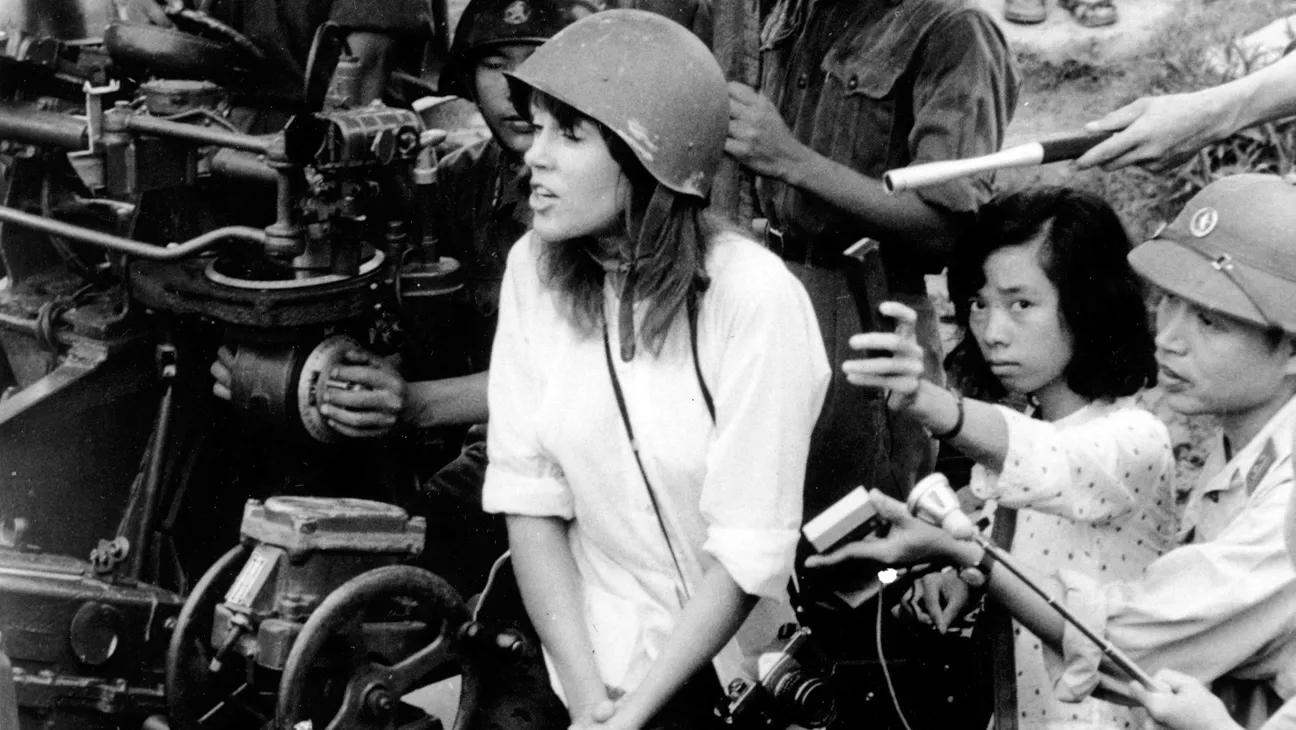
Figure 2. Fonda being interviewed whilst in Vietnam (Photo Credit: Nihon Denpa/AP)
After years of facing direct backlash from this photo, Fonda was essentially forced to make a public statement apologizing for the “betrayal,” as she understood it. Fonda has maintained that she was caught in the moment, as the photo was taken on the last day of her Hanoi visit.
Fonda continues to face the repercussions of this photograph as much of the public reflects on her anti-war legacy. Fonda is both admirable and condemnable as an anti-war activist for many. Although she has personally and publicly recognized the harm this photograph caused and has called it “a betrayal,” the controversy sparked by the image did not result in Fonda loosening her stance against U.S. military policy in Vietnam or her broader beliefs about war. Even amid the immediate backlash, Fonda continued to advocate for the anti-war effort, helping establish the Indochina Peace Campaign (IPC), which raised funds and supported the war protests.
This organization would plant the roots for IPC Productions, later known as Jane Fonda Films, through which Fonda would create “issue-driven” films in the late 70s and early 80s. These films included Coming Home (1978) (which brought Fonda her first Oscar for Best Actress), The China Syndrome (1979), and 9 to 5 (1980). These films addressed various social issues that Fonda was passionate about, including the effects of war on veterans, environmental crises, and women’s rights, particularly in the workforce. These films broadly demonstrate how Fonda's passion for activism extended beyond the Vietnam War to other issues and persisted even amid unrelenting backlash.
Fonda also built a successful entrepreneurial career, creating and marketing her popular home video program, Jane Fonda’s Workout. Through this, however, Fonda still found a way to combine her love for exercise with supporting causes she believed in, as much of her profits helped fund the Campaign for Economic Democracy, a leftist organization started by her husband at the time.
Current Focus and Vision
In recent years, Fonda has continued to stand up for issues that matter to her, particularly environmental issues. She protested the Dakota Access Pipeline in 2017 and, in 2019, began a recurring event called Fire Drill Fridays to raise awareness about climate change. Fonda reflects on her life of activism as joy-filled: “Some people think that being an activist means like, ‘Eat your broccoli,’ but it’s actually fun,” she said to Stephen Colbert. Fonda believes deeply in the work she has already done and hopes to continue her activism. As Fonda’s son said in a documentary about his mother’s activism, “She won't stop. She’s on a mission. This intent to do well keeps her demons at bay.”
 Primary Source Analysis

Photography Analysis

Oberserve
-
What do you notice first in this photograph?
-
Who is in the image, and what are they doing?
-
What details (clothing, expressions, setting) help you learn more about when or where this photo was taken?
Reflect
-
What emotions or messages do you think this image conveys?
-
Why might this moment have been photographed or shared publicly?
-
What does this photo suggest about Jane Fonda’s beliefs or actions during this time?
Wonder
-
What might have been happening in the world when this picture was taken?
-
How do you think different people might have reacted to this image?
-
What questions would you ask to better understand the story behind this photograph?
Fonda, Jane. Broadcast from Hanoi. August 22, 1972. https://www.digitalhistory.uh.edu/active_learning/explorations/vietnam/fonda.cfm
Fonda, Jane. “My Life So Far.” August 25, 2022. https://janefonda.com/my-life-so-far/
Gajanan, Mahita. “From ‘Hanoi Jane’ to the Workout: A Brief History of Jane Fonda’s Activism.” Time.com, September 25, 2018, N.PAG. https://time.com/5400822/jane-fonda-hbo-documentary-activist/
Martin, Annie. "Jane Fonda explains how activism can be joyful". United Press International, March 5, 2021. https://www.upi.com/Entertainment_News/2021/03/05/Jane-Fonda-joy-activism-anti-war/5331614952344/
Rolston, Matthew. “Jane and Tulea.” https://janefonda.com/photos/.
Svoboda, Cynthia J. W. “Jane Fonda's Visit to North Vietnam Outrages Many Americans,” EBSCO. 2022. https://www.ebsco.com/research-starters/political-science/jane-fondas-visit-north-vietnam-outrages-many-americans.
MLA: Vandy, Scottie. “Jane Fonda.” National Women’s History Museum, 2025. Date accessed.
Chicago: Vandy, Scottie. “Jane Fonda.” National Women’s History Museum. 2025 https://www.womenshistory.org/education-resources/biographies/jane-fonda